
In 1976, a 26-year-old biologist camped alone beneath a 35-foot artificial eagle nest: One chick she raised went on to father around 70 more
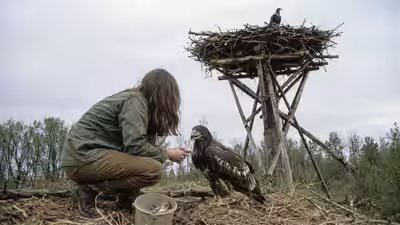
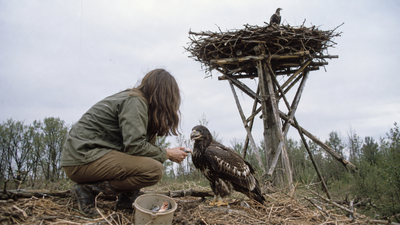
Tina Morris was 26 years old when she spent months living alone beside an artificial nest at New York’s Montezuma National Wildlife Refuge. Her job was to raise young bald eagles and see whether they could survive after being released into the wild. The experiment began in 1976, when the species was still struggling after decades of persecution, habitat loss and the effects of DDT. Morris was a graduate student at Cornell’s Laboratory of Ornithology when she was selected for the project. The U.S. Fish and Wildlife Service says she eventually spent two years working with seven eaglets at Montezuma, near Seneca Falls, New York.The young eagles lived in a man-made nest about 35 feet above the ground, while Morris stayed nearby and watched them from a concealed position. She did not have a lot of experience caring for eagles and was also afraid of heights. Each day, she climbed the tower to provide food without allowing the birds to become dependent on human contact. The goal was to use a technique known as hacking, in which young birds are raised in a controlled setting before being released to live independently. The method had been used with other raptors, but applying it to bald eagles was still an experiment.
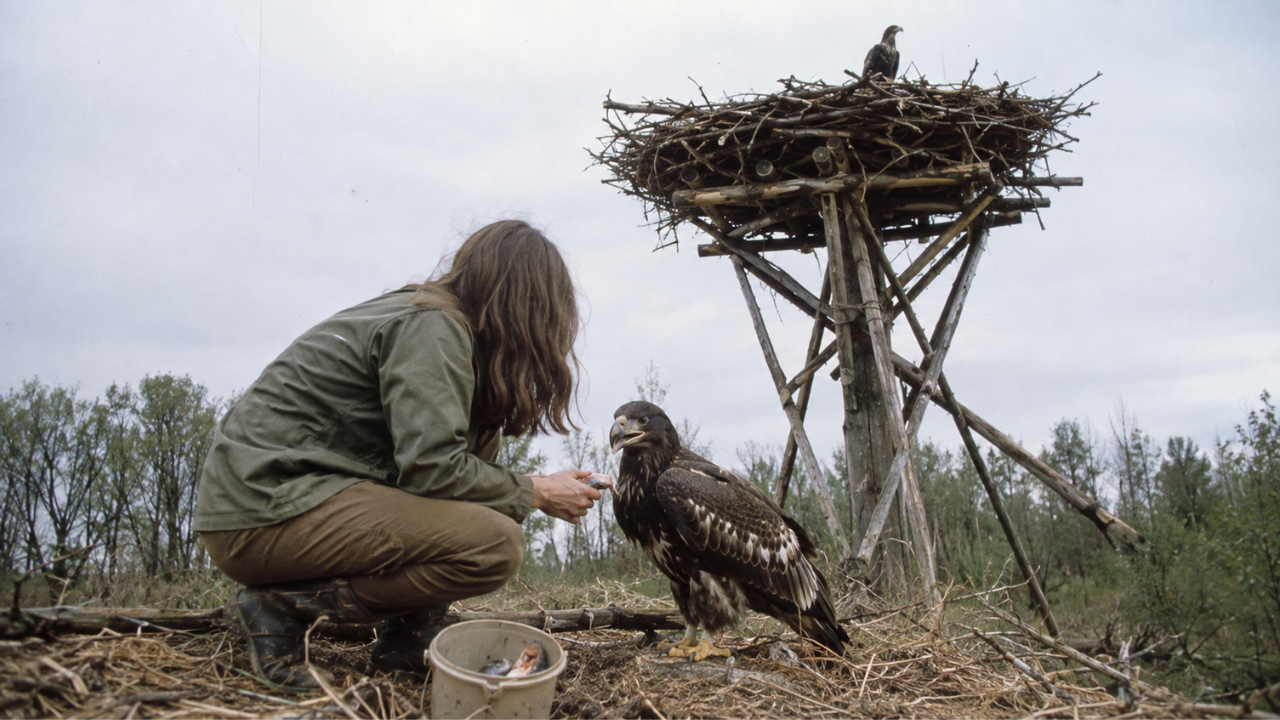
AI REPRESENTATION: The goal was to use a technique known as hacking, in which young birds are raised in a controlled setting before being released to live independently | ChatGPT
The eagles had to learn to live without peopleMorris could not simply feed the eaglets by hand, since that would risk imprinting, which would make the young birds associate humans with food. Instead, she stayed out of sight and delivered food to the nest using a long stick. She collected roadkill and caught carp, then used a barbecue fork attached to the stick to place the food within reach of the growing birds. Morris also watched their behavior closely and tracked them once they began leaving the nest.The first two eaglets arrived from Wisconsin in June 1976. They were designated W1 and W2. A third bird, known as M3, arrived later after being found in Michigan with a broken leg. The leg had been treated before he joined Morris’s group. M3 had already been handled by people unlike the first two birds but had not become imprinted on them. Morris later recalled developing a particular attachment to him.Young eagles do not immediately have the control needed for long flights or safe landings. Morris had to track them after they left the tower and retrieve them when they landed in dangerous places. One of the birds ended up in a marsh and had to be carried back to the tower. The work was practical rather than glamorous, since Morris spent much of her time watching, feeding, climbing and searching for birds that had disappeared into the refuge.What made M3 so special?The first group eventually left the area as independent birds. Morris returned to the project in 1977, when she helped raise another four eaglets. By then, the basic approach had proved workable, and other researchers became involved. The New York State Department of Environmental Conservation later took over the program.M3’s story continued even after Morris’s time at Montezuma ended. The eagle was identified by his band number, 03142, and eventually settled in New York. He lived for about 35 years and fathered an estimated 70 offspring, according to accounts of Morris’s research and memoir. Morris did not initially know that the eagle was M3; she sadly learned his identity after the bird was killed by a vehicle while feeding on roadkill.The figure of 70 should be treated as an estimate rather than a precise count. It refers to chicks that are attributed to M3 during his life, not to 70 descendants across multiple generations. His story nevertheless gave Morris an unusually direct link to the long-term results of the experiment she had worked on as a young biologist.
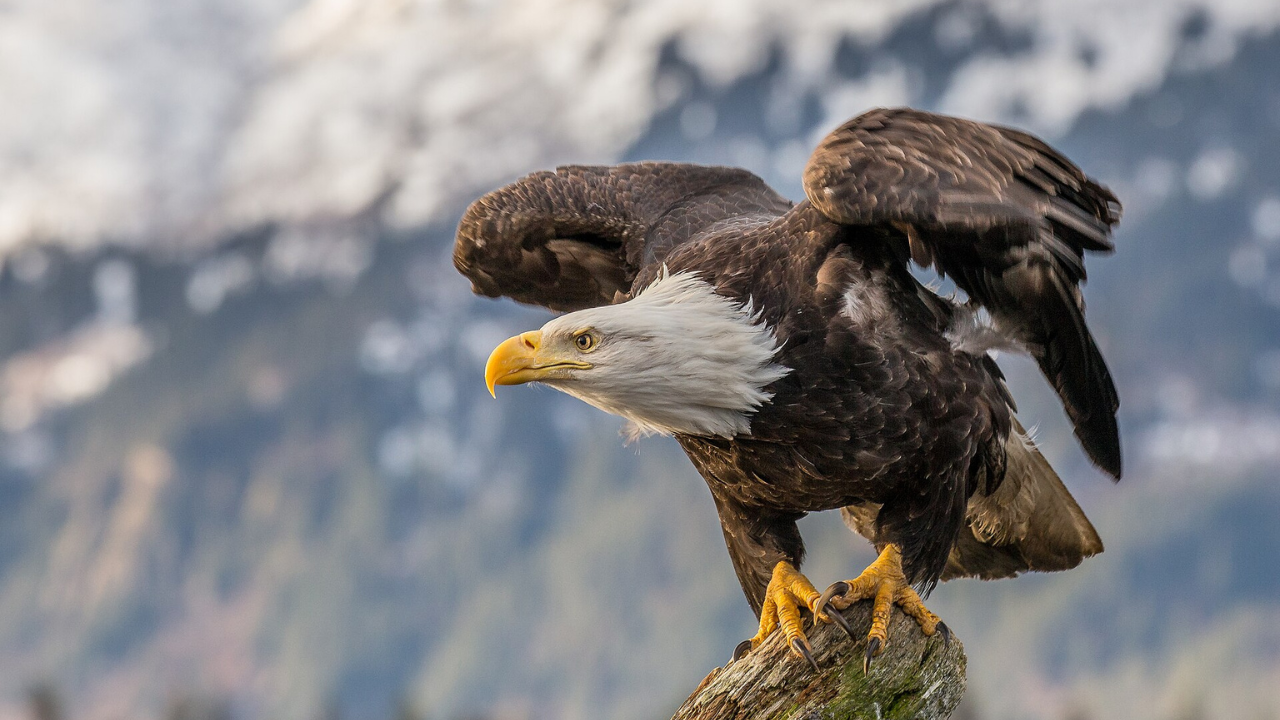
Bald eagle | Wikimedia Commons
A species once down to 417 nesting pairsThe bald eagle’s situation in the United States was far more serious when Morris began her work. In 1963, only 417 known nesting pairs remained in the lower 48 states, according to the U.S. Fish and Wildlife Service. DDT was a major factor, which accumulated through the food chain and interfered with the birds’ ability to produce strong eggshells. Habitat loss, shooting and other pressures had also reduced populations.The species eventually made a major recovery. In 2007, the Fish and Wildlife Service removed the bald eagle from the federal endangered and threatened species list after determining that populations in the lower 48 had recovered. The agency estimated 9,789 breeding pairs at the time. A later federal estimate based on 2018-2019 data put the population at about 316,700 individual bald eagles, including 71,467 breeding pairs.Laws protecting eagles, the U.S. ban on DDT, habitat protection and other conservation programs all played major roles. But the work at Montezuma helped establish a practical method for releasing young bald eagles into areas where the species had disappeared. Nearly five decades later, the experiment is preserved not only in conservation records but also in the story of M3, one of the eaglets Morris once watched from a hidden position beside a 35-foot nest.