
Before you hit send: Common emoji mistakes that can lead to misunderstandings in office emails and team chats |
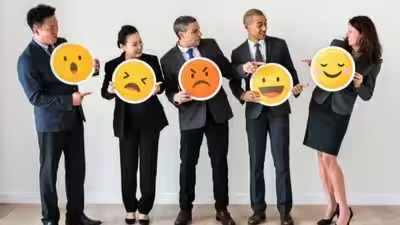

A manager replies to a completed project with a simple thumbs-up. To some people reading it, that’s a perfectly normal sign-off, quick, clear approval. To others, particularly younger colleagues, it can land as clipped, dismissive, or even faintly hostile. Welcome to one of the more quietly disruptive problems in modern office communication. Digital communication has genuinely become a generational minefield, with well-intentioned emojis regularly creating confusion and occasional conflict among colleagues who assumed they were being perfectly clear. With most workplace conversation now happening over Slack, Teams, and email rather than face to face, a single misread emoji can do more damage to a working relationship than people realise. Here are the mistakes worth knowing before your next message goes out.
Assuming the thumbs-up means what it always meant
No single emoji has caused more workplace confusion than this one. Among younger workers, using a thumbs-up or a red heart emoji is increasingly seen as a sign someone is “officially old,” and a meaningful share of younger professionals view the thumbs-up specifically as rude or hostile rather than affirming. For older colleagues, the same emoji is simply a fast, efficient way to signal agreement. Neither reading is wrong exactly, they’re just operating on completely different rulebooks, which is precisely why the gap causes so much friction.
Treating the slightly smiling face as automatically friendly
This one catches people off guard because it seems like the safest, most neutral emoji available. In practice, many younger workers read the simple, closed-mouth smiling face not as warm or friendly at all, but as condescending or even faintly sarcastic, closer to a tight, forced smile than a genuine one. Someone sending it with entirely good intentions, especially to soften a piece of feedback, may be landing the exact opposite tone they were aiming for. If warmth is the actual goal, a more open, expressive emoji tends to translate far more reliably across age groups than this particular one does.
Using a celebratory emoji without any context
Clapping hands seems like an obviously positive gesture, congratulations, well done, nice work. For a lot of older professionals, it still is. But among younger colleagues, the same clapping emoji is increasingly used as sarcastic emphasis instead, closer to a slow, mocking round of applause than genuine praise. Sent on its own, with no accompanying text, there’s no way for the recipient to know which version was intended, which means a manager trying to celebrate a colleague’s work genuinely risks the message reading as backhanded instead.
Sending a heart emoji to a colleague
A red heart feels like a low-stakes, friendly way to express appreciation, but it carries more baggage in a professional setting than most people account for. Beyond the same “officially old” perception younger workers attach to it, there’s also a noticeable gender split on how acceptable it feels at work, with men generally more likely than women to consider a heart emoji inappropriate in a work message. Given how easily it can also be misread as overly personal or even flirtatious depending on the relationship and context, it’s one of the easier emojis to simply leave out of a professional exchange altogether.
Assuming an emoji means the same thing everywhere
For workplaces with colleagues spread across regions or countries, generational gaps aren’t the only source of confusion, culture plays a real role too. The loudly crying face, for instance, is often assumed to universally signal either sadness or exaggerated laughter, but in some regions it’s used specifically to express stress or emotional overwhelm, while elsewhere the exact same emoji reads as melodramatic or flippant. For any team communicating across geographies, an emoji that feels obvious and safe to one person may carry a completely different emotional weight for a colleague reading it from somewhere else entirely.
Letting the emoji do all the talking
The simplest fix across nearly every mistake on this list is also the most overlooked: pairing an emoji with a sentence that makes the intended tone unmistakable. A bare thumbs-up can read as abrupt, but “Thanks again for handling that” alongside it leaves no room for misinterpretation. The same logic applies to a clapping emoji, adding even a short line about exactly what’s being celebrated turns a symbol that could be read as sarcastic into one that’s unambiguously sincere. The emoji isn’t the problem by itself, it’s when it’s asked to carry the entire message alone.
A small symbol, a genuinely bigger stakes than it looks
This isn’t purely an etiquette issue either. Workplace disputes involving emoji misinterpretation have become common enough that they’ve started showing up in formal complaints and even legal proceedings, particularly around workplace conduct and discrimination cases where tone genuinely mattered. Most day-to-day emoji confusion will never escalate that far, but it’s a useful reminder that the gap between what you meant and what landed isn’t always harmless. A few extra words alongside an emoji costs almost nothing to type, and it’s often the difference between a message that builds trust and one that quietly chips away at it.
Disclaimer:
This article is intended for general informational purposes only. Emoji interpretation can vary widely by individual, workplace culture, industry, and region, and the patterns described here are general trends rather than universal rules. When in doubt about tone in a professional message, it’s usually safer to pair emojis with clear, explicit language rather than relying on the symbol alone.