Why Supriya Sule’s delimitation hint has Delhi buzzing
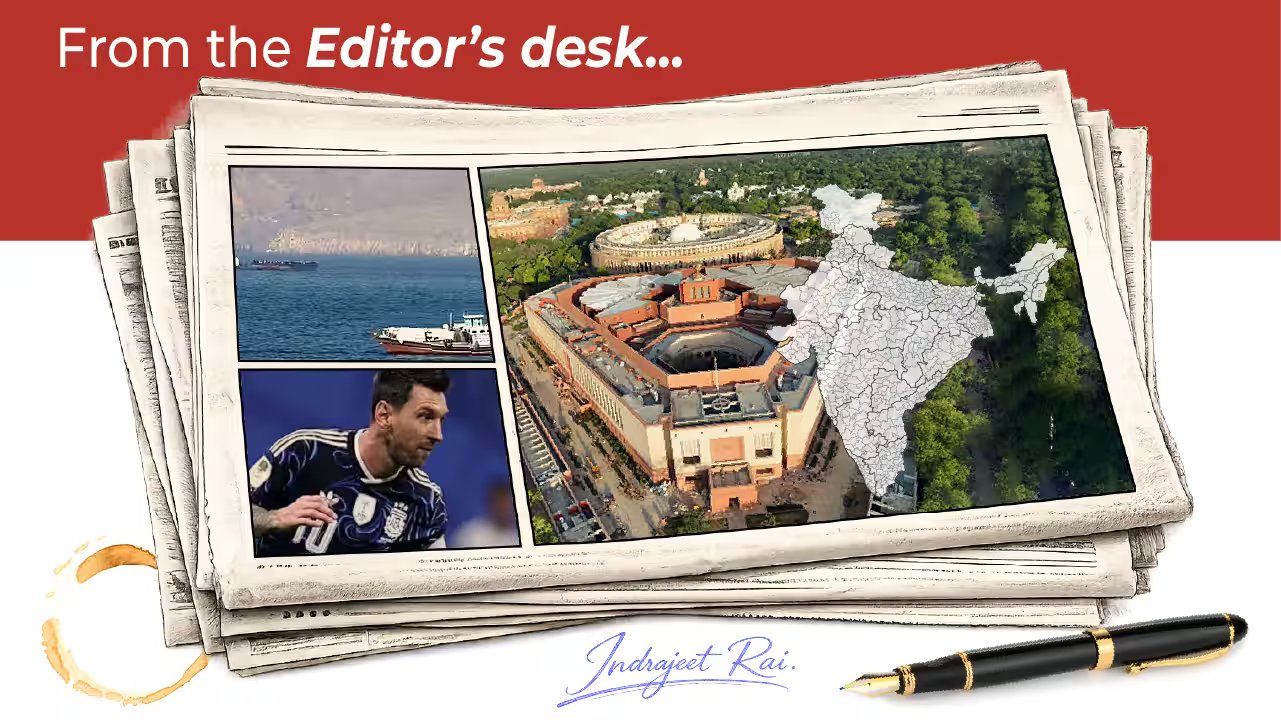
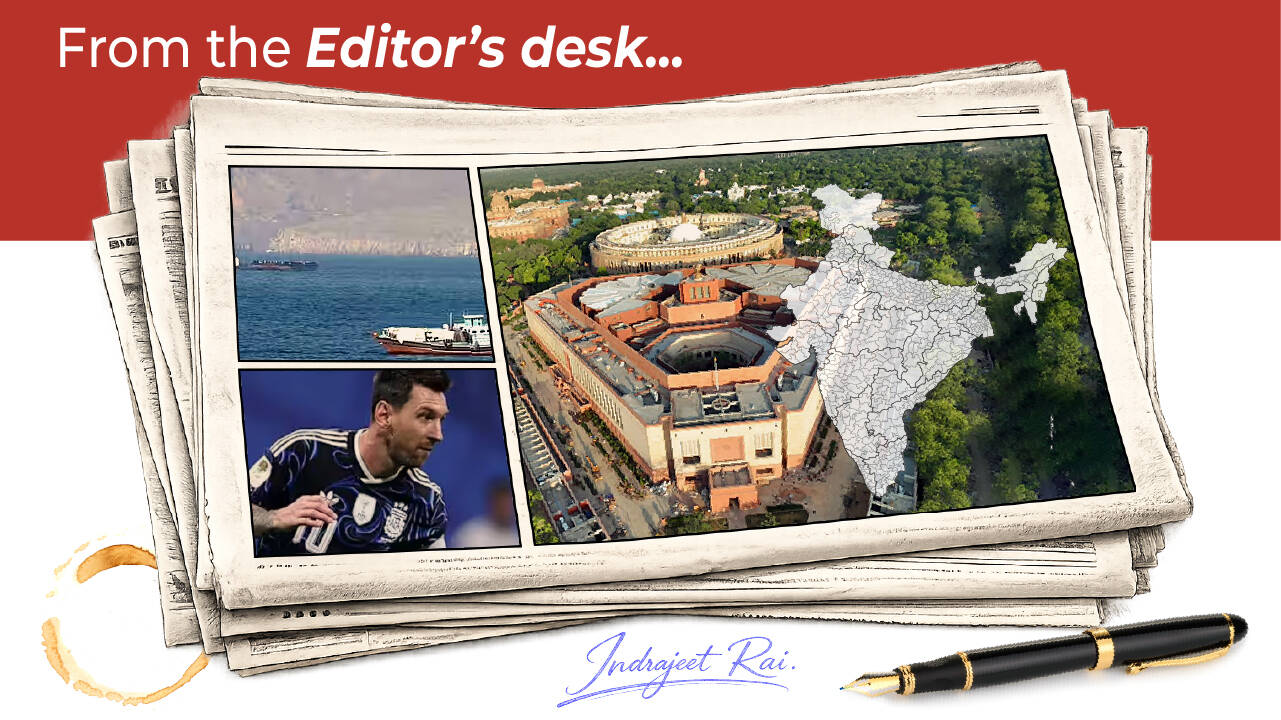

This week, we are tracking
- Delimitation debate: BJP gets warm with Sharad Pawar’s party
- India’s ‘invisible army’ in the Hormuz Strait
- Xi’s Pakistan, the field marshal of Trump
- Chip, Chip, Hooray and the China issue
- 48 to 2: The perfect World Cup finale? Argentina vs Spain
The 850-seat question: Why Supriya Sule’s delimitation hint has Delhi buzzing
In politics, an “if” can mean more than an outright yes.
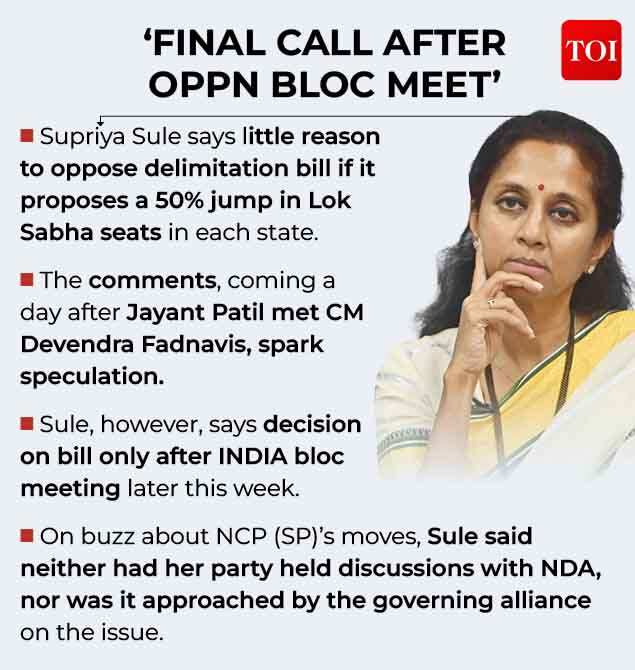
Supriya Sule has said the NCP (SP) could consider supporting the government’s delimitation plan if every state receives a uniform 50% increase in its Lok Sabha seats. The party, she added, would first discuss the proposal within the INDIA bloc.
On paper, this is not a dramatic ideological shift. Sule is essentially saying that her party will not oppose a fair expansion of Parliament. But timing is everything in politics and her remark has landed just as the Modi government is searching for the additional votes required to clear a constitutional amendment in the Monsoon session.

Why the formula matters
The Constitution (131st Amendment) Bill proposes raising the Lok Sabha’s maximum strength from 550 to 850. The government’s previous attempt failed in April, receiving 298 votes against 230: Well short of the constitutionally required two-thirds majority. The bill’s return, therefore, is not only about delimitation. It is also a test of whether the BJP can loosen the opposition’s grip over its regional allies.
Sule’s formula offers a possible escape route: Increase every state’s seats by the same proportion, thereby expanding Parliament without dramatically changing the federal balance.
Maharashtra adds the masala
Sule’s remarks came after senior NCP (SP) leader Jayant Patil met Maharashtra CM Devendra Fadnavis. It was Patil’s second closed-door meeting with a senior BJP leader within a week, following his interaction with Vinod Tawde.
Both Patil and Sule insist there is no political realignment underway. Yet Maharashtra’s opposition is understandably nervous, particularly after six Shiv Sena (UBT) MPs moved to Eknath Shinde’s camp.
Sharad Pawar’s politics has always thrived on keeping several doors slightly open. The current signals may represent negotiation rather than migration, but allies rarely enjoy seeing those doors.
Whither INDIA bloc?
The NCP (SP) may not possess the numbers to decide the vote alone. But its movement could produce a domino effect. The DMK may reconsider its position if all states are promised a 50% increase, while the Samajwadi Party could explore the middle path of abstention.
Congress has warned the NCP (SP) and DMK against breaking ranks. P Chidambaram argues that the bill is less about women’s representation and more about enabling delimitation and possible gerrymandering.
Strait of Hormuz: How India’s ‘invisible army’ keeps the world’s oil flowing
The ceasefire between the US and Iran seems to be stuck in on-off mode. Today they are talking about de-escalation and diplomacy; tomorrow, missiles are in the air again and ships are under attack.
When fighting breaks out in the Middle East, we usually talk about oil prices, the rupee and India’s energy security. But in the midst of these big geopolitical moves is India’s “invisible army” at sea.
A war they did not choose
Two Indian seafarers have died in recent days in attacks on ships in the region. After one of the men died, the government summoned Iran’s deputy ambassador and made a formal protest. Other Indians were said to have been injured.
The government has asked shipping companies and recruitment agencies not to put Indian sailors on ships that will transit the Hormuz till further notice. But while that may protect the next batch of workers, it offers little immediate comfort to those already at sea.
The hidden workforce
India is the world’s third-largest supplier of seafarers, with more than 300,000 Indians working on global shipping fleets. They operate tankers carrying oil, container ships laden with consumer goods, and bulk carriers loaded with the raw materials that keep factories running.
The ships usually fly foreign flags. The companies that employ these sailors are often based somewhere else entirely. And the families waiting for them are scattered across coastal towns in Kerala, Goa, Maharashtra, Tamil Nadu.
Seafarers can spend six, nine, even twelve months away from home at a stretch, reachable only through patchy satellite calls. Nobody notices until a ship catches fire, gets hijacked, or takes a missile.
So for now, new sailors stay home, spared a deployment that used to be routine. The ones already out there just wait, hoping the strait calms down before it’s their ship’s turn to cross it.
The bromance paradox: Trump loves Munir, Pakistan loves Xi
Asim Munir is a fan of Donald Trump. Since June 2025, the US president has spoken positively about the Pakistan army chief many times, describing him as an “exceptional man” and, most memorably, “my favorite field marshal.”
They talk a lot directly. It’s a real bromance.
But there’s one awkward wrinkle, and the Pew Research Center laid it out this week: Trump loves Munir. Munir leads a country that does not love Trump. That feeling is reserved for Xi Jinping.
Pew surveyed more than 42,000 people in 36 countries between February and May 2026, and the top-line finding is a first in the more than 20 years the center has been asking these questions: In most of those countries, more people now view China favourably than view the United States.
Twenty-five of the 36 countries are tilted towards China. Only six remain strongly American: Poland, the Philippines, South Korea, India, Japan and Israel.
Pakistan doesn’t just fit that trend, it defines it. Around 90% of Pakistanis view China favorably, the highest of any country surveyed. Asked which power is the more reliable partner, they picked China over the US by 84% to 36%.
The leadership numbers tell the same story. 83% of Pakistanis have confidence in Xi Jinping to do the right thing in world affairs — a striking figure in a country where politicians rarely poll that well. Pew’s researchers frame this as part of a wider pattern, not something specific to Pakistan: confidence in Xi has been climbing globally while confidence in Trump has been sliding.
Trump may believe personal chemistry can move geopolitics. In Pakistan, at least, it hasn’t. Munir gets the White House lunch. Xi gets the trust.
Chip, Chip, Hooray: The China question behind the government’s big bet on semiconductors
We make millions of smartphones, ship them all over the world and proudly call ourselves a manufacturing hub. But many of the most valuable parts inside those phones — especially the chips — are still made somewhere else.
The government now wants to change this.
The Union Cabinet has approved two schemes totalling Rs 1.9 lakh crore: Rs 1.275 lakh crore for the second phase of the India Semiconductor Mission (ISM 2.0) and Rs 62,500 crore for a new Mobile Phone Manufacturing Scheme.
Together, they are India’s effort to move from making finished gadgets to making more of what goes inside them.
Sand to silicon
ISM 2.0 is far more ambitious. It covers nearly the entire semiconductor chain: From silicon wafers and fabrication plants to chip packaging, speciality chemicals, gases, manufacturing equipment, research and design.
Thus, India isn’t just trying to get foreign companies to build chip factories here. It’s asking Indian companies to design chips, make some of the equipment and materials needed by those factories, and develop the skilled workforce required to sustain the ecosystem.
From grant to equity
The most interesting change is the way the government will support semiconductor startups. Instead of one-off grants, it’s developing a model of larger, milestone-based funding that would be paired with equity investments, potentially from venture capital firms as well.
The China question: Why this is bigger than chips
There is a bigger strategic calculation. In 2025-26, India’s imports stood at nearly $775 billion, with China’s share being almost one-fifth of it. Electronics, machinery, chemicals and many other industrial inputs still rely heavily on foreign suppliers.
The US-Iran conflict has shown how quickly a faraway war, a shipping-lane blockade or an export ban can hurt Indian factories and weigh on the rupee.
Semiconductors are particularly important because they are inside almost everything: Phones, cars, defence systems, medical equipment and household appliances. Countries that can’t count on getting chips can see large parts of their economy slow down.
Old king, young prince: Messi and Yamal chase World Cup history
Well, we got the final nobody could have written better. Defending champions Argentina play Spain for the crown. Depending on whom you ask, this is either the recoronation of the greatest player of all time or the passing of the torch to a young prince.
Let’s begin with the story of the headline. Messi is 39, this is almost certainly his last World Cup, and Argentina have looked like a team of destiny in getting here.


Lamine Yamal, who celebrated his 19th birthday during the tournament, is opposite him. Messi is the grand old order of football; Yamal is its impatient future.
The expanded 48-team tournament sometimes felt too long, too hot and too packed. But it has delivered a finale of beautiful simplicity: Europe vs South America, youth vs experience, Yamal vs Messi.
There is anticipation of perhaps the last great Messi moment or the beginning of the Yamal era, with everyone looking towards Sunday.
Editor’s picks: Some of our most and must-read articles
Lights out: How Iran quietly moved millions of barrels through Hormuz under America’s nose
Trump’s ‘guardian’ fee: How much would a supertanker have to pay to cross Strait of Hormuz?
Beyond saturation fire: Pinaka’s precision leap reshapes India’s deterrence
Why railways picked Jind-Sonipat route for its 1st hydrogen train
‘Earlier, the better’: Why SC wants Centre to rethink third language policy from class 9
Disclaimer
Views expressed above are the author’s own.