For decades, scientists searched for Mars’ lost ocean: A giant ‘bathtub ring’ may have finally revealed it |
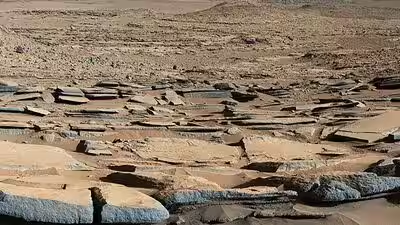
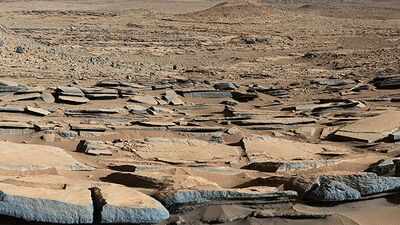
For years, the idea that Mars once held vast amounts of water has remained one of planetary science’s most persistent questions. Dry river valleys, mineral deposits, and ancient lake basins have all hinted that the planet looked very different billions of years ago, but proving the existence of a true ocean has been far more difficult. The biggest obstacle has always been the landscape itself. Features thought to be old shorelines appear at different heights across the planet, making it difficult to explain how they could have marked the edge of a single body of water. A new study approaches the problem from another direction. Instead of searching for beaches or coastal cliffs, scientists looked for a much broader geological fingerprint that oceans leave behind. Their analysis suggests Mars may still preserve the outline of a long-vanished sea stretching across much of its northern hemisphere.
Scientists found an Earth-like ocean signature on Mars
The search focused on a feature familiar to geologists studying Earth rather than Mars. When large oceans interact with continents over immense periods of time, they shape wide, gently sloping regions beneath the water along coastlines. These broad shelves remain part of the landscape even if the sea later disappears.To understand whether such a signature could survive on another planet, scientists first used computer models to strip Earth’s oceans away. Without the water, one feature consistently stood out: expansive, relatively flat bands surrounding continental margins. These geological shelves have remained surprisingly stable despite changes in sea level over millions of years, making them potentially more reliable indicators than ancient shoreline traces.That insight became the basis for examining Mars with a fresh perspective.
Mars may still preserve the outline of its ancient ocean
Using detailed elevation maps collected by orbiting spacecraft, the team searched the Martian surface for landforms matching the pattern seen on Earth. They identified an extensive flat zone in the planet’s northern hemisphere that closely resembles a continental shelf.The study published in Nature, titled ‘Identifying the topographic signature of early Martian oceans’ reveals that the structure lies well below the planet’s estimated sea level and extends around terrain that has long been considered a possible ocean basin. Rather than representing a narrow shoreline, it forms a much wider geological belt, similar to the submerged margins surrounding Earth’s continents.According to the researchers, the scale of the feature makes it difficult to explain as the edge of an isolated lake. Creating such an extensive shelf would likely have required a large body of water that remained in place over a long period.
An ocean that may have lasted for millions of years
If the interpretation is correct, the findings strengthen the case that northern Mars once contained an ocean covering roughly a third of the planet’s surface.Geological shelves develop gradually as waves, currents and sediment reshape coastlines over extended periods. That process takes far longer than the lifespan of temporary lakes created by floods or melting ice. Instead, it suggests relatively stable conditions that may have continued for millions of years.Such a long-lasting ocean would also imply that liquid water persisted under environmental conditions capable of sustaining it, rather than appearing only during brief episodes in Martian history.
Ancient river deltas add support to the Mars ocean theory
The existence of this coastline is far from being the only one that contributes to the hypothesis. Researchers have also analyzed the location of deltas that were formed by ancient rivers as a result of sediment accumulation at the place where rivers merged with a bigger body of water.Many Martian deltas seem to be arranged around this new shelf in such a way that this arrangement indicates the flow of rivers into a big Northern Ocean. Although the arrangement does not indicate the existence of the ocean, it is another geological clue that supports the same theory.Thus, the combination of the shelf and the arrangement of sediments allows one to make conclusions that the northern lowlands used to serve as a coherent marine environment rather than a system of lakes.
What it could mean for ancient life
The possibility of a long-lived ocean naturally raises questions about whether Mars once offered conditions suitable for life.Large bodies of water provide stable environments where sediments gradually accumulate. On Earth, these sediments often preserve chemical traces and fossils that record ancient ecosystems. If Mars experienced similar processes, deposits within its former coastal shelf could contain evidence of past microbial activity, should it ever have existed.That possibility makes the region an attractive destination for future exploration. Samples collected from ancient marine sediments could provide information that is unavailable from volcanic rocks or dried river channels elsewhere on the planet.
Questions that remain unanswered
Although the newly identified feature strengthens the argument for an ancient ocean, it does not settle every debate.Scientists still need to understand exactly how the Martian shelf formed and whether other geological processes might have produced a similar landscape without a long-standing ocean. Even on Earth, the development of continental shelves involves several interacting processes that are not yet fully understood.