Scientists have found a billion-year-old hidden magma system on Mars that supported life on the Red planet
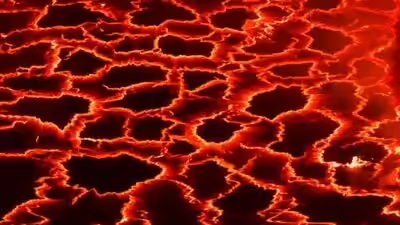
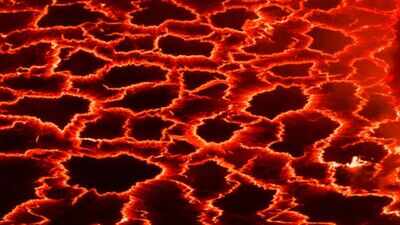
Out of all the planets in the solar system, Earth is held at the highest prominence. It’s consistent shift of the tectonic plates, existence of life and evolution have made it truly one of a kind.In contrast, Mars looks like a planet whose best days are behind it. Its volcanoes are extinct, its crust is still and it never even developed the shifting tectonic plates that constantly reshape Earth.But now, a new discovery has surprised the scientists. Deep beneath the surface of Mars, researchers have found evidence of an enormous magma system that once stretched through the planet’s entire crust.
A shocking discovery
Until now, scientists were of the thought that this kind of geological plumbing required tectonic plates. But now, they wonder, if Mars could build such a complex interior without moving plates, the ingredients for life may be more common on the planet.The evidence comes from NASA‘s InSight lander, which placed the first seismometer on the surface of the planet in 2018. It spent the next few years recording the planet’s faint internal tremors. Some of these tremors came from meteor strikes. Others came from marsquakes, the Martian versions of earthquakes.These recordings helped the researchers read the structure under the lander far more sharply and deeply than before. An earlier analysis of the same data showed that the Martian crust is built in layers rather than as one solid mass. Fractured, water-bearing rock lies near the top, giving way to denser material deeper below.About 15 miles down the crust, flowed a puzzle. Seismic waves changed speed sharply at that depth, marking a clear boundary, but still it remained unclear what lay inside. While some scientists deemed it an ancient layer of the crust, others saw it as an ordinary layering in the lower crust.
A tale of two layers
To understand what the boundary truly meant, a team led by geologist Dr Tobermory Mackay-Champion from the University of Oxford took a different approach. He and his colleagues gathered hundreds of possible rock recipes for the Martian interior. For each recipe, they calculated how fast seismic waves should travel through it, then compared those predictions with the speeds InSight had measured. The statistics did the rest. A scoring system ranked how well each rock type fit the data, layer by layer.Above the boundary, the rock behaved like basalt, the dark volcanic rock that covers much of the planet’s surface. But below it, the wave speeds were too fast for basalt. Instead, they matched a denser rock low in silica and rich in iron and magnesium, the kind geologists call ultramafic.The numbers also appeared lopsided. The upper rock had 86% chance of resembling basalt while the lower rock had about 91% probability of being ultramafic. Together, the results describe a band of dense, iron-rich rock roughly 9 miles thick at the base of the crust, beginning around 15 miles down, as per the study published in the journal Nature Astronomy.
Once there was magma…
A layer like this does not form easily. The team reads it as a thick pile of crystals that built up as magma pooled deep in the crust and slowly cooled. As the magma crystallised beneath Mars, the heaviest minerals settled and stacked up, while the lighter melt drained upward.At the temperatures Mars’ crust normally reaches, its lower layers should not have grown hot enough to melt. Their heat models show that only an unusually strong flow of heat from below could have driven that melting. The most likely source was hot mantle rising beneath and pushing fresh magma into the crust. Together, these processes make up transcrustal magmatism, a connected web of rock that melts, pools, and rises through the entire thickness of the crust.
The possibility of life
On Earth, systems like these sit beneath chains of volcanoes and help build continents. They were thought to need plate tectonics to run at all. What the team saw on Mars, is similar to processes studied on Earth for decades. A study of rocks on the floor of Jezero crater, examined up close by NASA’s Perseverance rover, described a similar crystal pile-up formed as a thick body of magma cooled.The lead author sees a broader lesson in the finding. “Mars could sustain large, long-lived systems where molten rock evolved and reprocessed itself throughout the entire crust,” said Mackay-Champion.This seismic boundary spreads across much of Mars’ northern hemisphere. If the team is right, the lighter melt squeezed out of that deep layer would have risen toward the surface over time. A study of paler, more silica-rich rock elsewhere on Mars suggests some of that rock did reach the surface.These deep magma systems are tied to how a planet builds an atmosphere and holds onto its water, the conditions that can keep a world warm enough for life. Earth shows the link.That kind of recycling helps hold the climate steady over billions of years, and researchers had long pinned the whole process on plate tectonics. Now, according to Professor Jon Wade, an Earth scientist at Oxford who worked on the study, the Martian finding challenges those assumptions. Because now, the floor is an ancient magma system that once threaded through the entire crust of Mars without moving a single plate.One of the big questions in planetary science is whether Earth is unique. With this finding, scientists are now motivated to look harder at the smaller, quieter worlds they once ignored.