China’s Tianwen 2 spacecraft begins investigating an asteroid that could be a fragment of the moon |

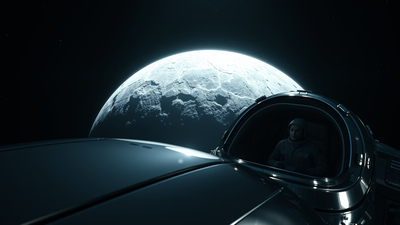
A tiny asteroid no wider than a football pitch has been quietly puzzling astronomers for years, and a Chinese spacecraft is now closing in on the answer. The asteroid, called Kamo’oalewa, is one of only a handful of objects known as Earth’s quasi moons, small bodies that circle the sun in near lockstep with our planet without ever being gravitationally bound to it. What makes this particular space rock so interesting is that its surface appears to reflect light in a way that closely resembles material from our own moon rather than a typical asteroid, leading some researchers to suspect it may actually be a chunk of lunar rock blasted into space long ago. China’s Tianwen 2 spacecraft, which has been travelling toward the object since launching in May 2025, is now finally close enough to start collecting the answers scientists have been chasing since Kamo’oalewa was first discovered.
What makes a quasi moon different from a real one
Quasi satellites like Kamo’oalewa are not moons in the traditional sense, since the moon stays near Earth because it is gravitationally bound to our planet, while quasi satellites remain gravitationally tied to the sun instead. From our vantage point on Earth, however, these objects can appear to trail alongside our planet for centuries at a time, tracing a strange, looping path around us even though they are technically orbiting the sun on their own. Kamo’oalewa was first spotted in 2016 by the Pan-STARRS telescope in Hawaii, and its Hawaiian name, roughly meaning an oscillating celestial fragment, was chosen through a student naming programme in 2019. Measuring somewhere between 40 and 100 metres across and spinning once every 28 minutes, it is among the more stable and closely studied of Earth’s seven known quasi moons.
The first clue pointing toward a lunar origin
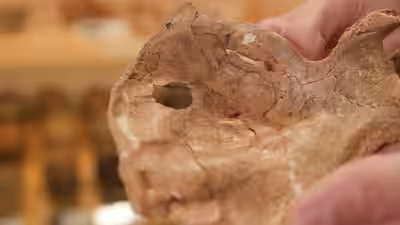
The idea that Kamo’oalewa might be a fragment of the moon first emerged in 2021, when a team of astronomers led by the University of Arizona pointed the Large Binocular Telescope and the Lowell Discovery Telescope at the object to study how it reflects sunlight. According to the study published in Communications Earth and Environment, the light Kamo’oalewa reflected did not match the spectrum of any typical near Earth asteroid, but instead closely resembled space weathered silicate rock similar to samples brought back by NASA’s Apollo missions. Researchers said the finding took years to confirm, since the observations were extraordinarily difficult given how faint and small the object actually is, but the eventual match to lunar material gave the team enough confidence to propose that Kamo’oalewa may have originated on the moon’s surface.
Working out how a lunar fragment could end up here
Confirming that Kamo’oalewa looked like moon rock was only part of the puzzle, since scientists also needed to explain how a piece of lunar material could plausibly end up in this kind of Earth like orbit in the first place. A separate team, also based at the University of Arizona, tackled this question by running detailed simulations of particles ejected from various points on the lunar surface at a range of speeds. According to a study published in the same journal, the researchers found that while most lunar debris capable of escaping the Earth moon system altogether would carry too much energy to settle into Kamo’oalewa’s kind of orbit, a small fraction of specific launch conditions, particularly ejections from the trailing side of the moon travelling just above lunar escape velocity, could plausibly produce exactly this outcome. The findings suggested that Kamo’oalewa’s unusual orbit was rare, but not impossible, for a genuine piece of the moon.
Why Tianwen 2 could finally settle the debate
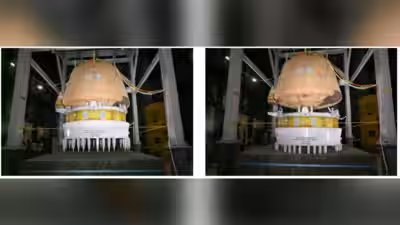
Telescopes on Earth can only take scientists so far when studying an object this small and distant, which is exactly why China’s Tianwen 2 mission was designed to travel out and study Kamo’oalewa directly. The spacecraft performed a key engine burn on June 7, 2026, bringing it into orbit around the asteroid, and its close encounter is expected to begin around July 4, when it will approach within roughly twenty kilometres of the surface. Over the following months, Tianwen 2 will use lidar, cameras and sounding radar to map the asteroid in detail before attempting to collect between two hundred and one thousand grams of surface material using two different sampling techniques, aiming to bring those samples back to Earth by late 2027. Once analysed in a laboratory, this material should be able to settle the question definitively, confirming whether Kamo’oalewa really is a fragment of the moon or simply an ordinary asteroid whose surface happens to have been unusually weathered over millions of years in space.