At this World Cup, the most famous brands are the invisible ones
A story of tape, tarps and attention worth billions.
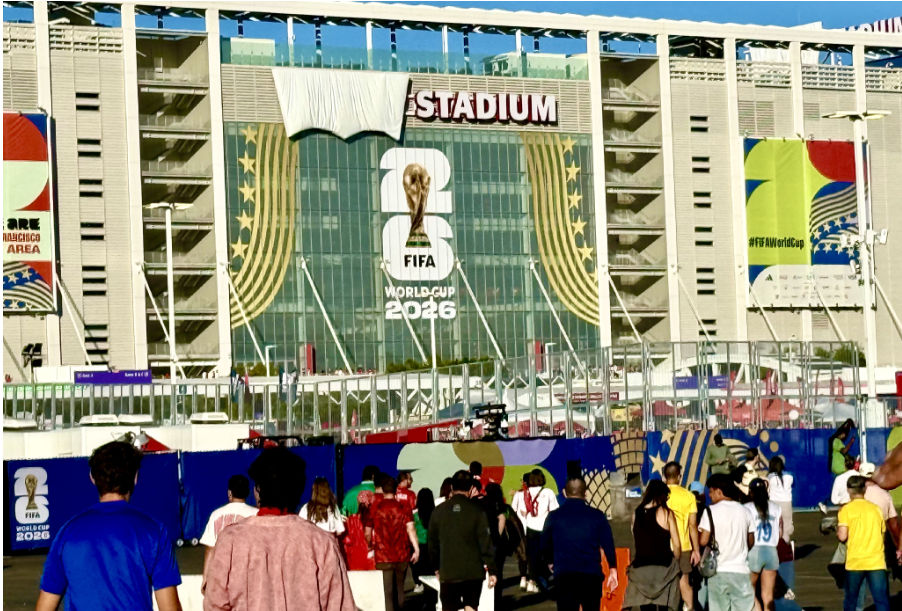

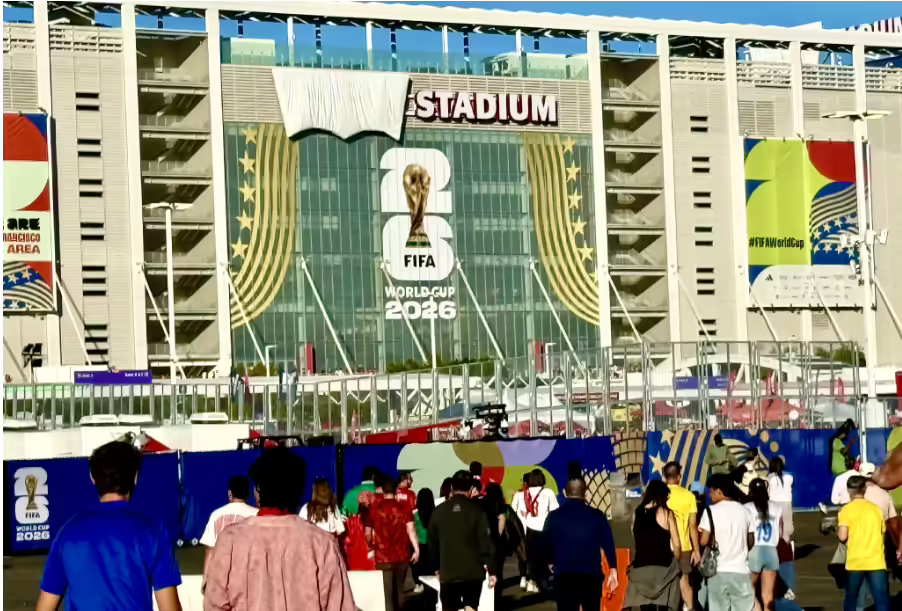
The white tarp at top left hides the Levi’s logo at the renamed San Francisco Bay Area Stadium, a few feet from FIFA’s own World Cup branding.
In the summer of 1998, the most talked-about advertisement at the World Cup in France was made by a company that had not paid a single franc to be there.
Nike was not an official FIFA sponsor that year. Its great rival Adidas was. Yet Nike produced a commercial of the Brazilian national team playing keepie-uppie through an airport terminal, Ronaldo, Rivaldo, and Roberto Carlos flicking the ball off check-in desks and baggage carousels, that became one of the most beloved sports ads ever made. It never mentioned FIFA. It did not need to. The ad was so good that fans walked away remembering Nike, not Adidas, the brand that had actually paid for the privilege of being there. The gatecrasher stole the show from the host.
FIFA never forgot it. Almost every commercial rule the organization enforces today can be traced back to decades of being quietly outwitted by brands that were never invited to the party. Nearly thirty years later, that long memory explains one of the strangest sights of the 2026 tournament: thousands of stadium seats in Foxborough, Massachusetts, each with a tiny square of blue tape stuck over the logo printed on it. To understand how we got from a clever airport advert to taping individual seats, you have to look at what FIFA now protects, and how fiercely.
Sixteen stadiums, a thousand hidden logos
The 2026 World Cup is the first to span three countries and 48 teams, played across 16 of North America’s most recognisable venues. If you have been watching and failed to recognise any of them, that is by design. FIFA enforces what it calls a clean stadium policy: during the tournament, no branding from any company that is not an official sponsor may appear anywhere a camera might catch it. Logos are covered, and the stadiums themselves are renamed.
So SoFi Stadium in Los Angeles became, simply, Los Angeles Stadium. MetLife Stadium, which hosts the final, became New York New Jersey Stadium. AT&T Stadium in Dallas became Dallas Stadium. Gillette Stadium near Boston became Boston Stadium. Down the list it goes, sixteen famous names temporarily erased. The one stubborn exception was the giant Mercedes-Benz star on the roof of the Atlanta stadium, which engineers concluded could not be covered without damaging the retractable roof. FIFA reportedly negotiated for eighteen months before granting it a reluctant exemption.
The scale of the operation bordered on the absurd. The clearest example is Gillette Stadium near Boston, home of the New England Patriots, renamed Boston Stadium for the tournament. Gillette, a razor brand owned by Procter and Gamble, is not a FIFA sponsor, so its name had to vanish. The catch is that the Gillette logo is printed on the seats themselves. Every single one. So crews worked through the stadium placing a small strip of blue tape over the logo on each of its 64,146 seats, one at a time.
A fan did the arithmetic, photographed a single taped seat, and posted it online. The image travelled around the world and drew far more attention to Gillette than an uncovered logo ever would have. NBC Sports and USA Today both sent reporters to confirm it was real. It was.
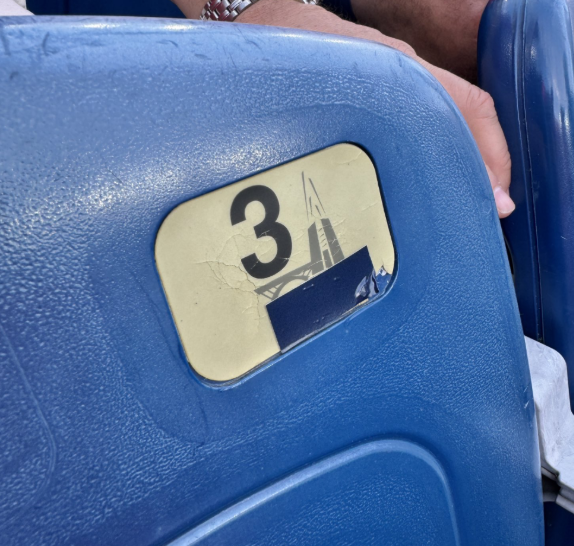

One strip of tape over the wordmark, on one of 64,146 seats at the renamed Boston Stadium.
The brands that won by losing
Here is where it gets fun. Faced with having their names blacked out in their own buildings, a handful of brands did something smarter than complain. They leaned in.
Levi’s, whose Santa Clara stadium became San Francisco Bay Area Stadium, had its giant logo draped in a plain white tarp. The trouble for FIFA is that the Levi’s batwing is so recognisable that its silhouette showed through anyway. So Levi’s changed its social media profile picture to the blanked-out logo and posted, deadpan, about welcoming the world to the beautiful redacted stadium, set to a viral TikTok sound. Lumen, the telecom firm behind Seattle’s stadium, went further: its chief marketing officer filmed himself cheerfully helping the crew cover up his own company’s signs, a fiber-network boss playing along with the joke. And Gillette, thanks to those 64,146 taped seats, became a national talking point without spending a single dollar on tournament rights.
You have to admire the judo of it. These brands could not buy official exposure, so they manufactured their own out of the very rule designed to silence them. The cover-up became the campaign. It is the Nike airport ad all over again, updated for the age of the screenshot, and it is some of the most quietly clever marketing of the entire tournament.
What a hidden logo is actually worth
Behind the wit sits a serious number, and this is where the story stops being about marketing and starts being about assets. Stadium naming rights are not vanity purchases. They are long-dated, contracted assets bought to guarantee years of visibility. SoFi is paying roughly $625 million over twenty years for its name, about $31 million a year. MetLife committed around $17 million a year back in 2011 on a 25-year deal.
Now consider what the clean stadium policy does to that asset. During the single most-watched sporting event ever staged inside these buildings, the asset is switched off. One sports valuation firm estimated the lost brand value for the naming sponsors at between $5 million and $9 million per group-stage match, rising sharply through the knockouts to as much as $80 million for the final at MetLife alone. A company that bought two decades of guaranteed exposure finds its single biggest moment handed to someone else.
That reframes everything. Exposure is not a soft, fuzzy thing you sprinkle on a brand. It is a scarce, measurable, ownable asset with a price per game, an owner, and a party that controls when it switches on. FIFA understands this better than anyone. It protects an estimated $1.8 billion in marketing revenue precisely by manufacturing scarcity, because exclusivity is the only thing that makes attention valuable in the first place. Strip away the spectacle and the World Cup is, at its core, the most sophisticated machine ever built for turning attention into money.
Why founders should treat being known as an asset
There is a lesson in that for anyone building a company. For most of the last century, advertising was filed under costs, a line item you spent against revenue and hoped it worked. What the FIFA economy makes obvious is that being known is not a cost at all. It is an asset, and a durable one. The reason the Levi’s batwing is recognisable enough to show through a tarp is that the company spent decades building that recognition, and it is now worth more than much of what sits on its balance sheet. Brand equity, unlike a performance ad campaign, does not stop working the day you stop paying for it.
For a founder weighing where to put scarce early capital, that distinction matters more than almost any other. Money spent building genuine brand equity is an investment in an asset that compounds and keeps paying back long after the spend. Money poured into short-term performance ads is closer to rent, useful, but gone the moment the budget runs out. The brands that endure understand this early and treat being known and trusted as something to own, not merely to buy by the month. It is why a single clever, earned moment, like Levi’s turning its own censorship into a campaign, can be worth more than millions in paid placement. Attention that feels authentic is the scarcest kind of all.
The blue tape lesson
Which returns us to that single taped seat in Boston. Somewhere, a person was handed tens of thousands of small squares of blue tape and asked to cover a razor logo one seat at a time, so that a brand which had not paid FIFA would not catch a free second of fame on camera. It is faintly ridiculous. It is also one of the most revealing images of how modern business works.
The thread running from a Nike advert in 1998 to a taped seat in 2026 is a single idea: attention has quietly become one of the most valuable assets in commerce. The brands that thrive are not always the ones that spend the most to be seen. Often, they are the ones clever enough to turn even a ban into visibility, as Levi’s and Gillette did. And the smartest operators, in sport, media and investing alike, are the ones who stopped treating attention as a cost to be managed and started treating it as an asset to be built and owned. FIFA worked this out long ago. The rest of the market is finally catching up.
Disclaimer
Views expressed above are the author’s own.