
Random Musing: Why Elon Musk becoming a trillionaire isn’t the real headline |
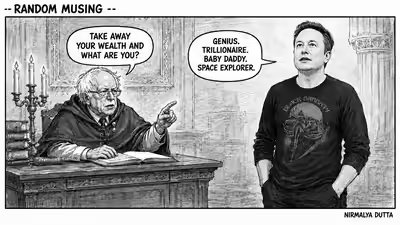
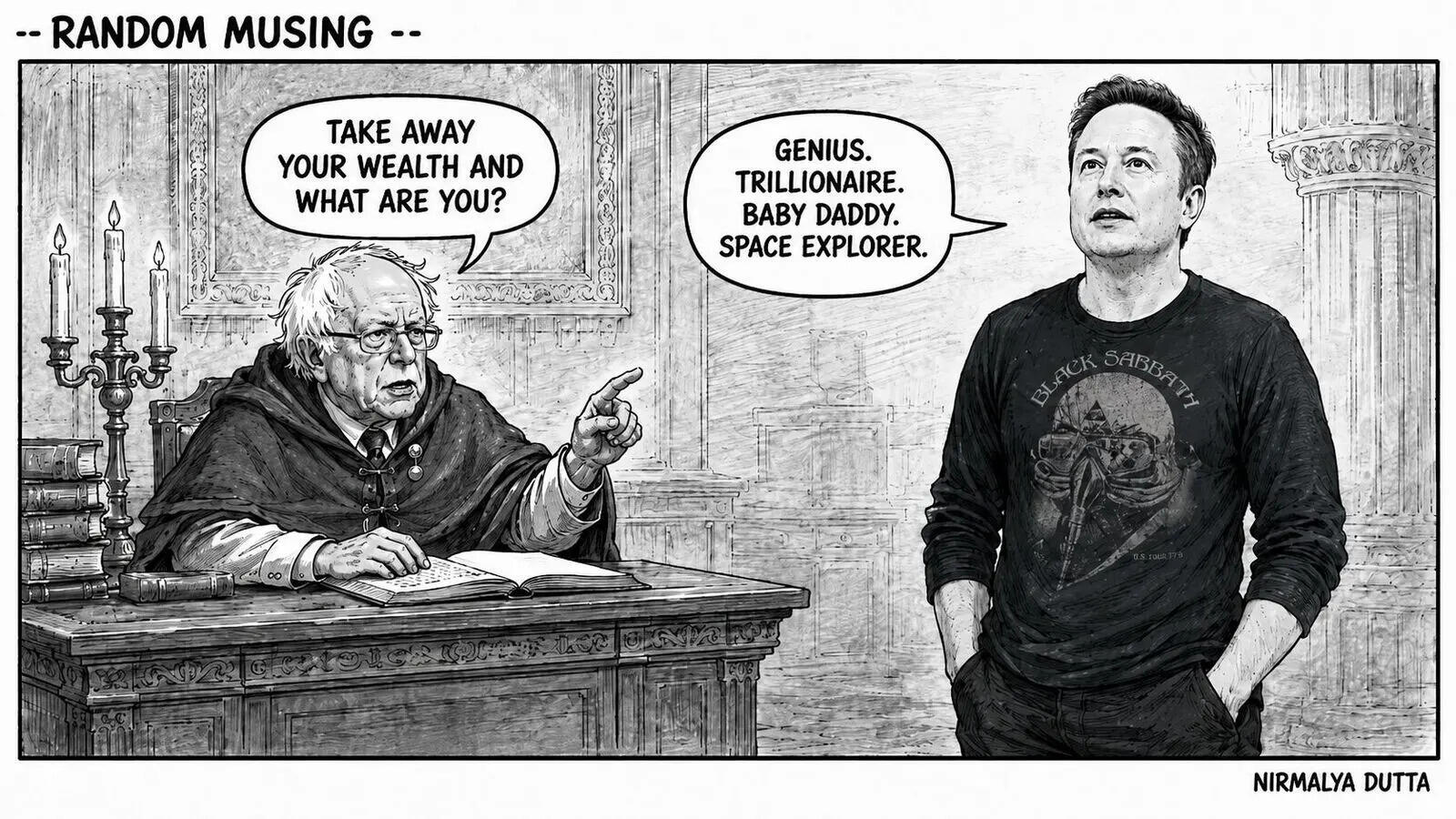
One of the best moments in the first Avengers movie came when Captain America asked Tony Stark: “Take away your suit and what are you?”A nonchalant Stark replies: “Genius. Billionaire. Playboy. Philanthropist.”Musk, who makes a cameo in the second Iron Man movie, must be wondering: gareeb saala. Particularly after the recent SpaceX IPO that made him the world’s first trillionaire.So exactly how rich is Musk right now?Well, he is already about 3.7 times richer than the world’s second-richest person. But that comparison is lacking. The gap between Musk and Larry Page, who has only $294 billion, is larger than the gap between the average person and Larry Page.Musk is now so rich that he easily dwarfs almost every single person, real or fictional, historical or present.Between 2002 and 2013, Forbes published the Fictional 15, a list that estimated the wealth of fictional characters such as Scrooge McDuck, Bruce Wayne, Tony Stark and even Smaug the dragon. Long before Musk, real-world figures like Carlos Slim and Bill Gates had overtaken the fictional rich. In Forbes’ fictional lists, Scrooge McDuck was valued at $65.4 billion, Smaug at $54.1 billion, Tony Stark at $12.4 billion and Bruce Wayne at $9.2 billion.Musk towers over their paltry fortunes.At about $1.1 trillion, he is worth roughly 17 Scrooge McDucks, 20 Smaugs, 89 Tony Starks and 120 Batmen. In fact, one would have to go beyond Forbes’ methods to find someone who can beat him, and that is T’Challa.
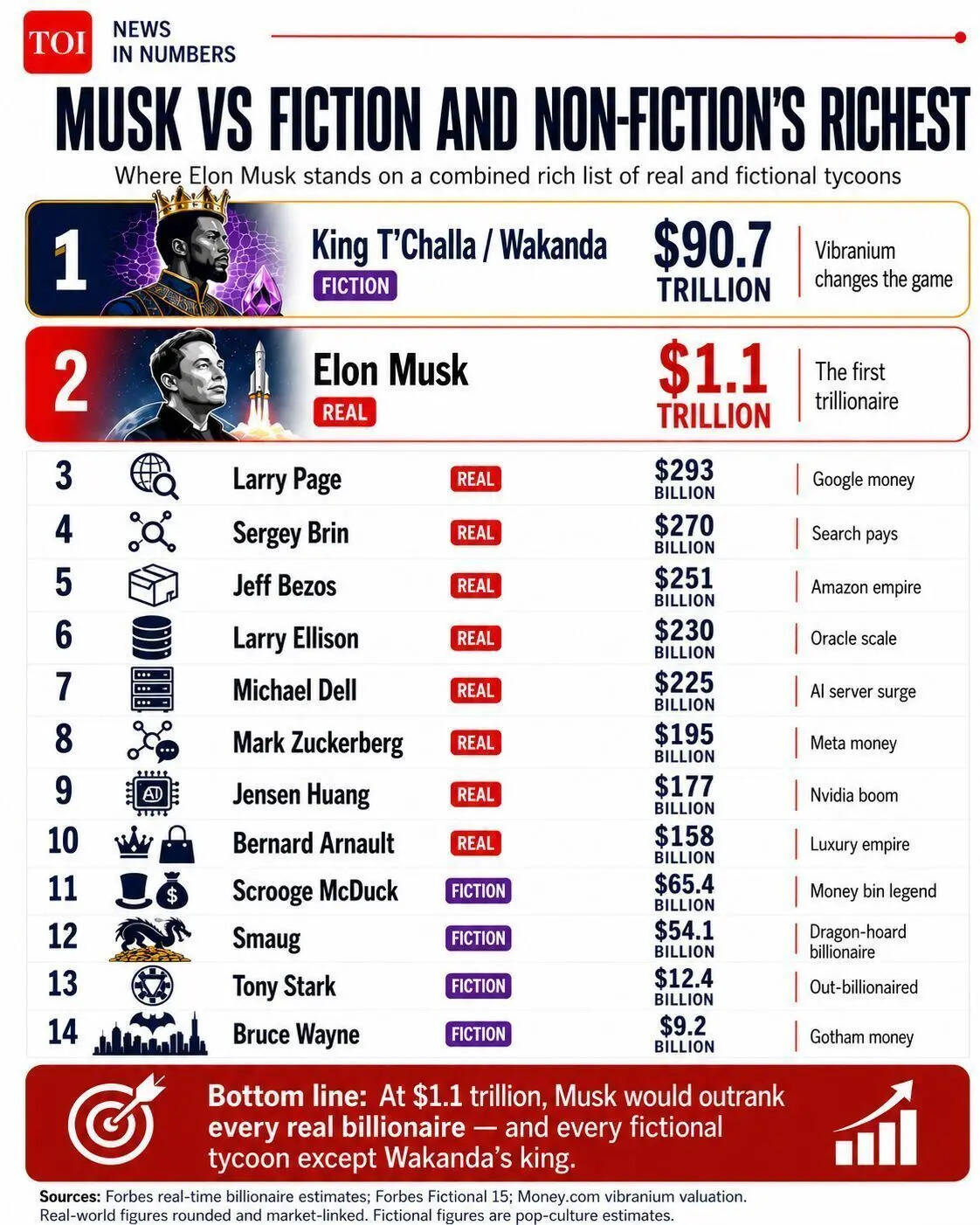
In the comics, vibranium is priced at $10,000 per gram and Wakanda holds about 10,000 tons of it, which means the king of Wakanda is worth $90.7 trillion. Given Musk’s utterances in recent years, one would wonder if he would be irritated by the fact that the only man richer than him is a black African man.But is Musk the richest ever in history?Now let us adjust that for inflation.John D Rockefeller, the American benchmark, ends up at around $645 billion in 2026 dollars. Andrew Carnegie, the steel magnate, is usually placed in the $380 billion to $470 billion range in 2026 dollars. Jakob Fugger, the Renaissance banker who financed emperors and popes, is often dollarised at around $410 billion or more in 2026 dollars. The Nizam of Hyderabad, once one of the richest men in the world, is commonly placed at around $215 billion in 2026 dollars.The harder cases are rulers such as Augustus Caesar or Mansa Musa, where personal wealth and state power blur, though Democrats would argue that Musk already has too much power in the current American state.
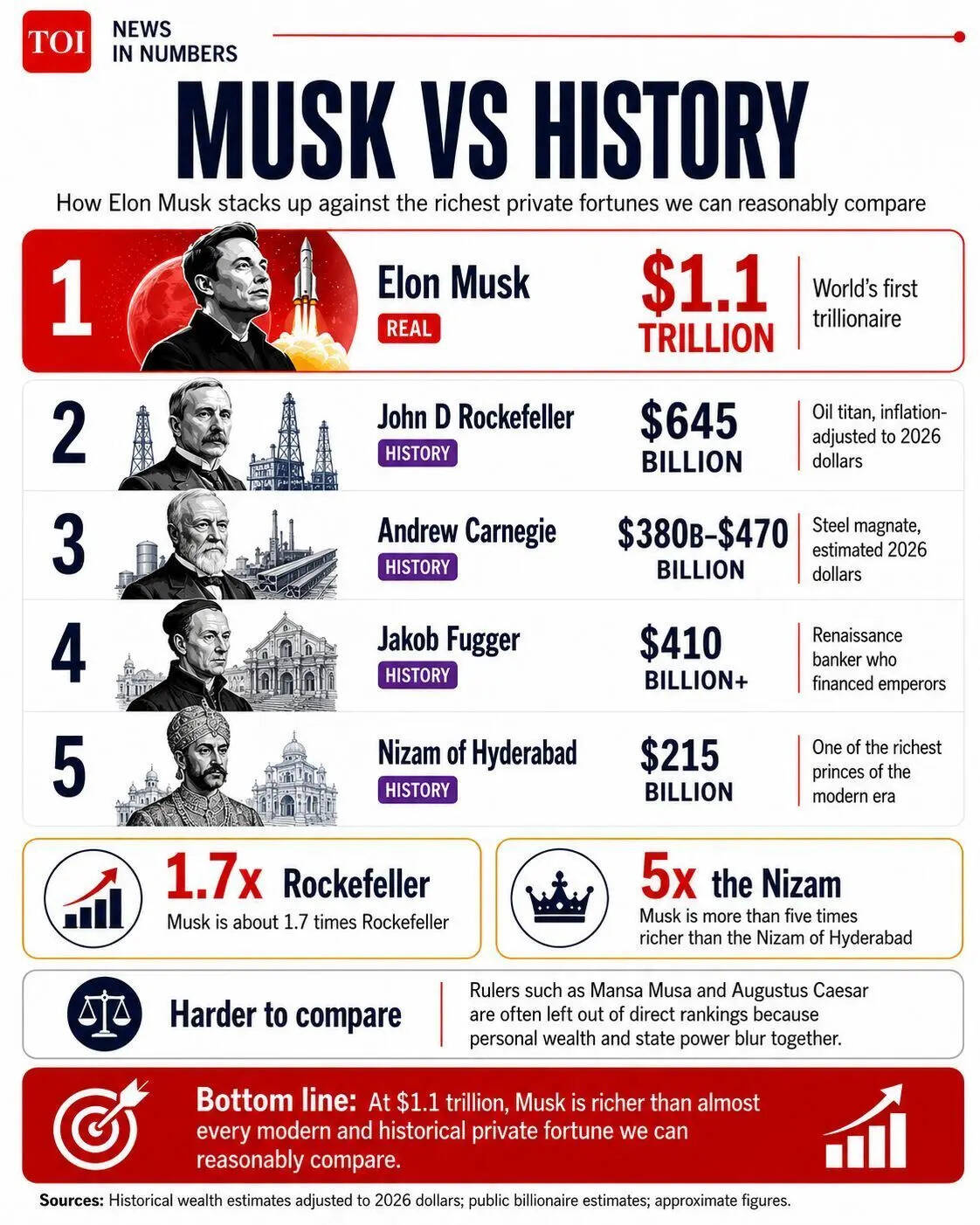
Ergo, it is safe to say: Musk is richer than almost every modern and historical private fortune we can reasonably compare. But history’s emperors and gold kings would complicate the arithmetic.Adam Smith’s Wealth of Nations is often considered the Bible of capitalism. Musk could write the fan-fiction sequel. So another way to make sense of Musk’s wealth is to compare it with countries.This is not a perfect comparison. GDP is annual output; Musk’s wealth is the market value of assets he owns. Switzerland does not lose 20% of GDP because investors suddenly decide mountains are overvalued.Still, the comparison gives some context.
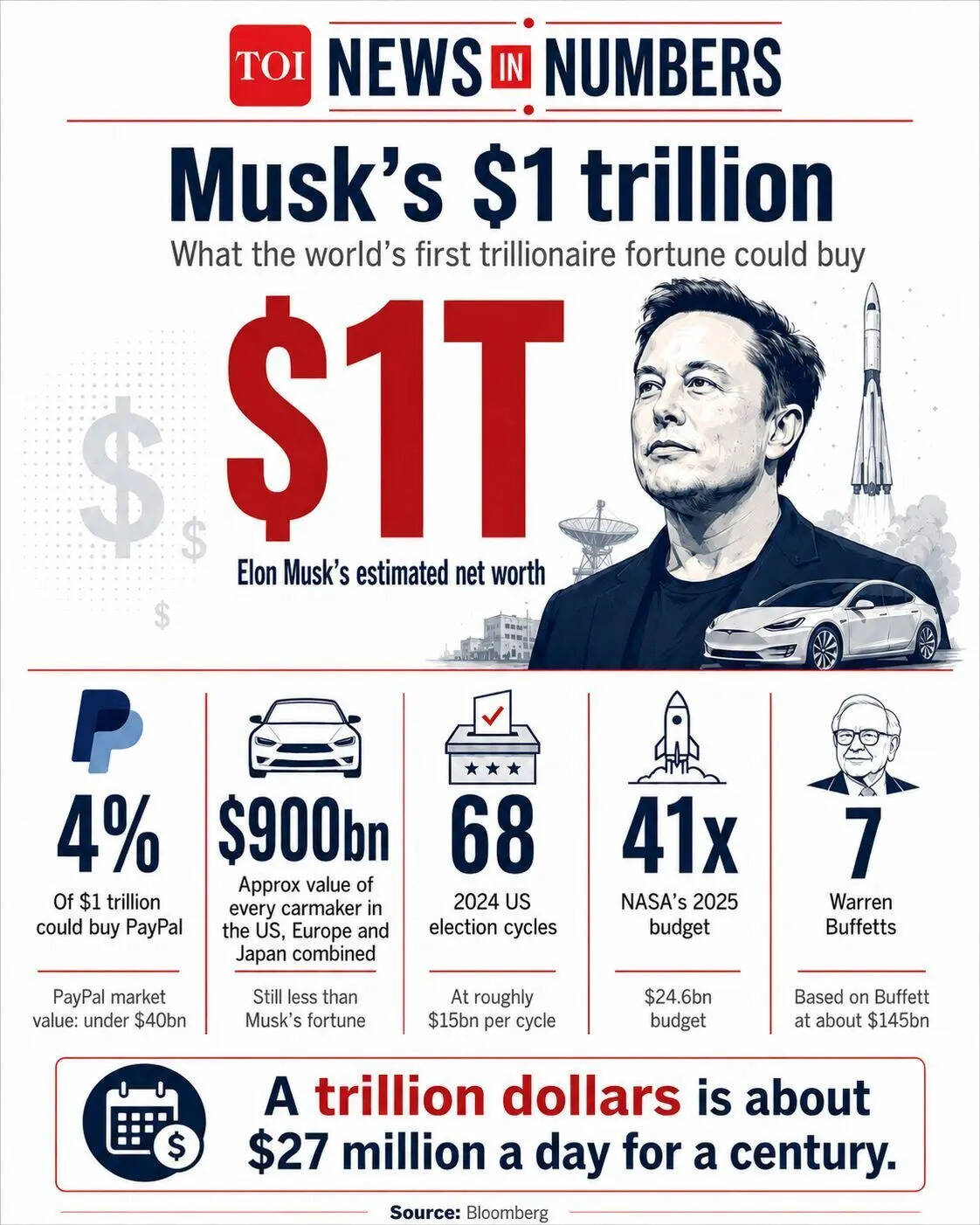
At $1.1 trillion, Musk would sit around No. 22 on the 2026 nominal GDP table. Only 21 countries or economies are larger. He is just below Switzerland and Poland, and above Taiwan. His paper fortune is larger than the annual output of Ireland, Belgium, Sweden, Israel, Argentina, Singapore, the UAE and Norway.But that is not the real headline of a man amassing so much wealth. The harder, stranger story is whether SpaceX is being valued not merely as a rocket company, but as the base layer of the next economy.Because that $1.1 trillion may still be the tip of the iceberg. Elon Musk could get a lot richer if SpaceX manages to do what it has been promising, and if investors are right about why they have paid so much to get into the lobby.Most space companies are still stuck at the transportation stage. They are all trying to solve one problem: can we reduce the cost of moving mass into orbit?That is the whole game.
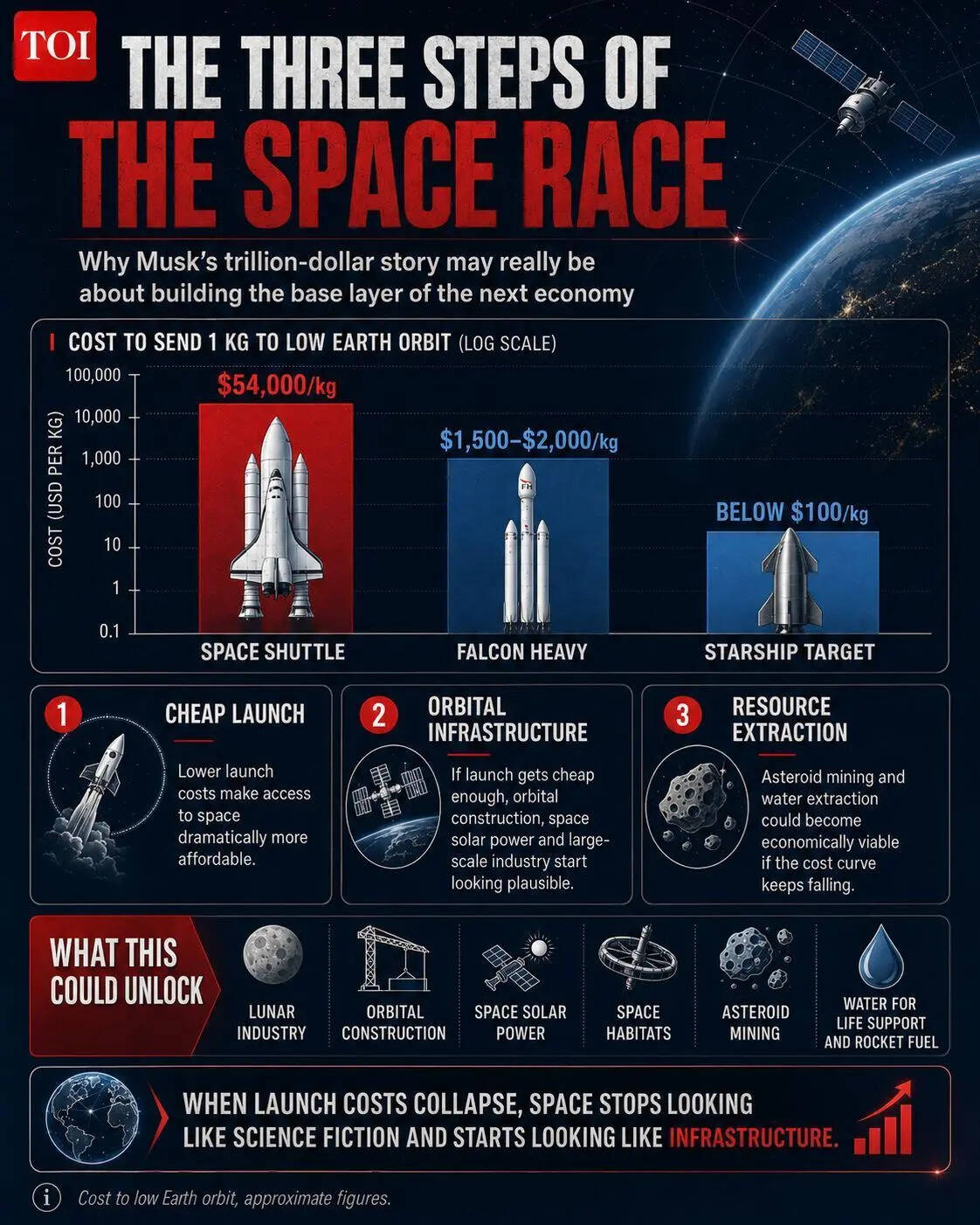
The Space Shuttle cost roughly $54,000 per kg to low Earth orbit. Falcon Heavy brought that down to roughly $1,500-$2,000 per kg. Starship’s ambition is to push that below $100 per kg.If that happens, the economics of space change completely. Things that were once the preserve of science fiction quickly become plausible: lunar industry, orbital construction, space solar power, asteroid mining and space habitats.That is step one.Step two is orbital infrastructure.Bezos often argues that Earth should be zoned for living and nature while heavy industry ought to move to space. To the modern mind, it sounds absurd, but so did the idea of splitting the atom or sending a man to the Moon a century ago. In space, solar energy is constant, and there is no atmosphere, no weather, no monsoon and no pesky NIMBY objecting to orbital parking.Then comes stage three: resource extraction. Crudely put, asteroid mining like Armagedon. Companies such as Deep Space Industries and Planetary Resources failed in the 2010s partly because the infrastructure was not ready, which made them economically unviable.But if cheap launch changes the cost curve, the dream starts looking less ridiculous.And the real resource in space may not be platinum or gold, but what Jesus turned into wine: water. It can support life, shield against radiation and be split into hydrogen and oxygen for rocket propellant. A water-rich asteroid is a super-powered coconut, a floating fuel station, oxygen cylinder and settlement starter kit.Then come the metals: nickel, cobalt, platinum-group metals, rare minerals and whatever else future industry needs. And yes, if humanity ever finds something vibranium-adjacent in an asteroid, Wakanda’s accountants should start worrying.Perhaps that is why SpaceX made so much in its IPO.The valuation is not just about rockets or SpaceX as a launch company. It is about whether SpaceX becomes the base layer of a future space economy: launch, satellites, internet, orbital construction, lunar logistics, asteroid resources, space solar power and habitats.
The closest analogy is Amazon Web Services, which gave computing infrastructure to thousands of start-ups. SpaceX could become the AWS of space.If Starship becomes a reusable interplanetary freight system, SpaceX does not have to mine every asteroid, build every habitat or manufacture every orbital solar panel. It only has to make those things economically viable for others.During the California Gold Rush, there was a saying that one could make more money selling picks and shovels to miners than by actually striking gold. More recently, the analogy has been used to describe people like Jensen Huang, who are providing the hardware to build AI. Musk could be creating the stepping stone for Space Race 2.0.Of course, all of this sounds downright absurd, something far beyond our comprehension. But then again, there have always been people who created things that their own civilisation would have considered fantasy.Imagine telling a person from 1926 what life is like in 2026.Tell them that ordinary people fly across oceans in metal tubes while eating reheated food and complaining about legroom. Tell them that a device smaller than a cigarette case lets you speak face to face with someone on another continent. Tell them that maps now know where you are, cars can drive themselves badly, money moves invisibly, diseases are beaten by vaccines made at impossible speed, and a teenager can watch any film, song, war, speech, sermon or stupidity ever recorded while sitting on a toilet.Tell them that rockets no longer simply fall into the sea. Some come back and land upright like obedient pencils.Tell them that machines can write essays, draw pictures, diagnose diseases, translate languages and pretend to be clever in ways that are often impressive and occasionally intolerable, and that they are perhaps better copy editors than many people who went to Oxford or Cambridge.To a person in 1926, much of 2026 would sound like an Isaac Asimov novel written by Stephenie Meyer. Asteroid mining and extra-planetary habitation might sound ridiculous, but so would pocket computers, global video calls, organ transplants, satellites, antibiotics, nuclear power, GPS, AI and Trump as president.The real headline is not that Elon Musk became a trillionaire.That is the easy story.The harder, stranger story is that SpaceX may be building the road to the next economy.
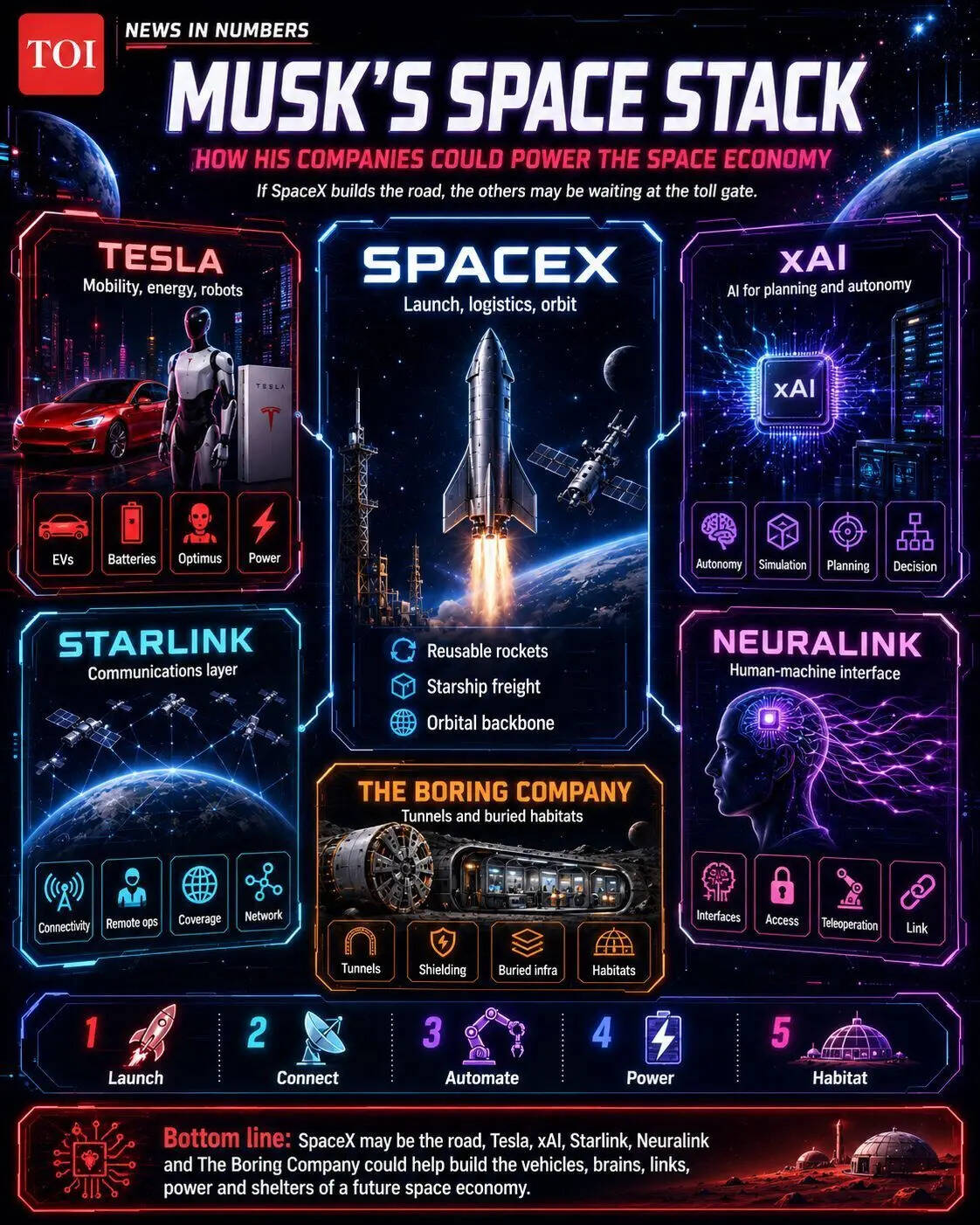
And if SpaceX builds the road, Musk’s other companies may be waiting at the toll gate: Tesla for vehicles, batteries, robotics and energy; xAI for artificial intelligence; Starlink for communications; Neuralink for human-machine interfaces; and The Boring Company for the underground habitats that may one day matter on the Moon or Mars.Many years ago, Apple popularised the line that the people crazy enough to think they can change the world are the ones who do.In the past, several of Musk’s endeavours have left a lasting impact on our lives, even if we realise it or not. Zip2 was the precursor to digital mapping and location services. PayPal revolutionised digital payments and is the father of modern fintech. Tesla launched at a time when both EVs and self-driving cars were sci-tech fantasies. Starlink provides internet services in remote corners of the world. Neuralink has already allowed a quadriplegic to interact with a computer using his thoughts.Musk may be many things, not all of them pleasant, but he is certainly someone who could ensure that science fiction no longer remains fiction.