
Who is in charge of our cities?


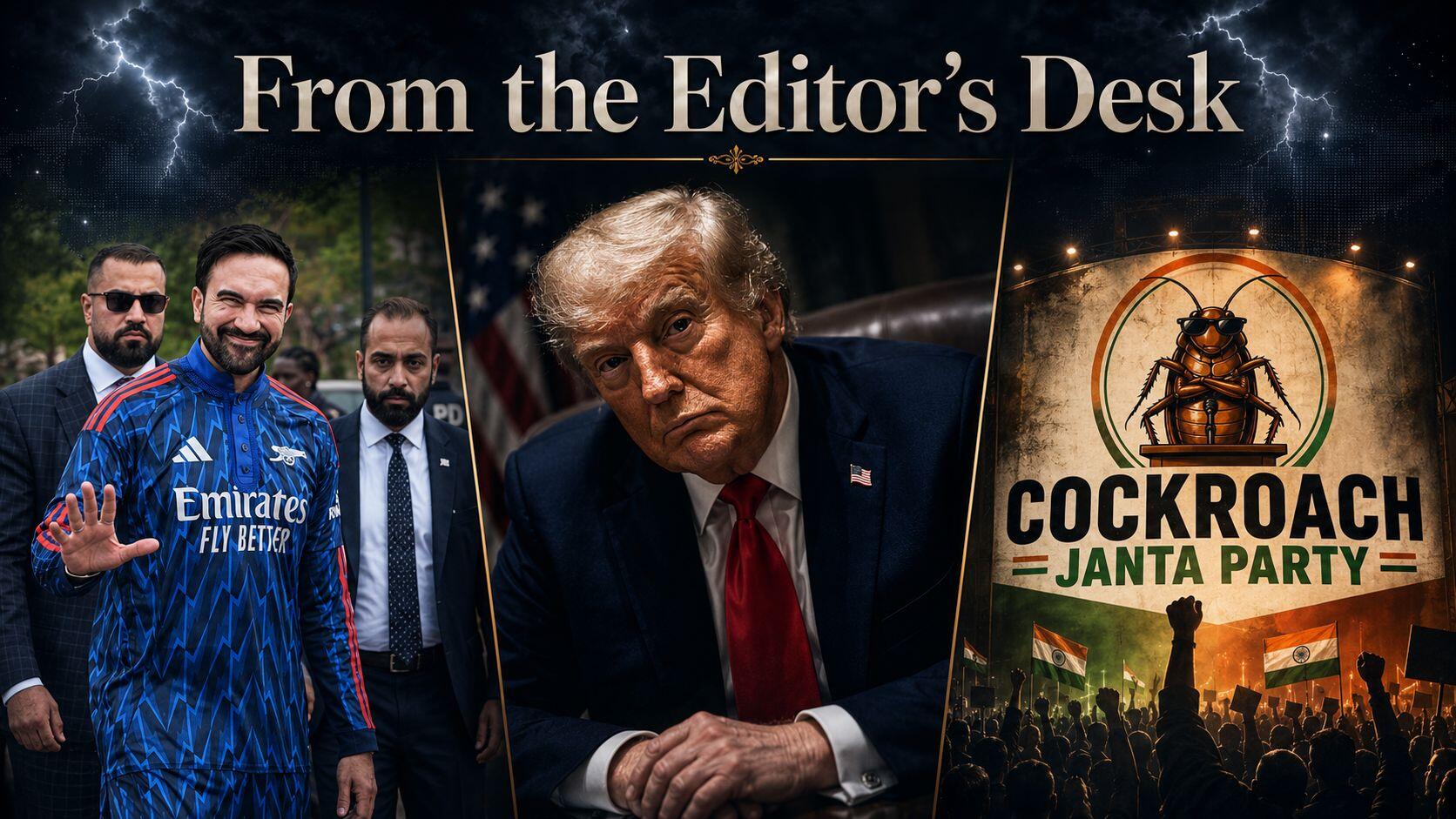
Here’s what we’re tracking:
- A deadly Delhi fire exposes how cities fail their most vulnerable
- Can students turn a meme-party into a protest vehicle?
- Why corporate India is being pushed out of its comfort zone
- Trump’s Iran brinkmanship and the limits of “deal-making”
- Who gets blamed when French fries become a proxy for diabetes risk
Fire, collapse and chaos: Do Indian cities need their own Mamdanis?
Every few months, one of our megacities gives us the same nightmare. A coaching centre with poor exits. A guest house that turns into a deathtrap. A building that should never have been allowed to rise. Fire tenders stuck in narrow lanes. Rescue teams delayed. Neighbours becoming first responders because the system arrives late.
This time, it was Delhi – twice.
In Hauz Rani, a fire tore through Flourish Stay Bed & Breakfast, killing 21 people and injuring 20 others. Many of the victims were foreigners who had come to Delhi for medical treatment.
Days earlier, in Saidulajab, a five-storey commercial building folded into itself. Six people died in a nearby canteen. The building allegedly had two illegal extra floors. Two MCD engineers were suspended. A culpable homicide case was filed. A magisterial inquiry was ordered.
You know the script. FIRs. Suspensions. Crackdowns. A few demolitions. A few raids. A city-wide “drive” against unsafe buildings. Then silence. Until the next disaster.
India does not lack laws. Fire codes exist. Building bylaws exist. Inspectors exist. Police exist. Disaster response teams exist.
The harder question is: Who owns the city enough to be blamed before people die?
Ideally, that person should be the mayor. But in most Indian cities, mayors are not real commanders. They are often ribbon-cutters. Real power is scattered across municipal commissioners, state governments, fire departments, police, development authorities, PWDs, water boards and electricity agencies.
In Delhi, the maze is even more complicated because of overlapping state and central control. So when a deathtrap hotel is allowed to run, blame spreads everywhere. Which means it lands nowhere.
That is why the US-style “strong mayor” model keeps coming up. In New York, Indian-origin Mayor Zohran Mamdani is the city’s chief executive. He has a four-year term, proposes the budget, oversees services and appoints key agency heads. The city charter says the mayor “shall exercise all the powers vested in the city.”
Voters know whom to reward. More importantly, they know whom to punish.
Now imagine Delhi, Mumbai, Bengaluru or Hyderabad with a directly elected mayor who actually controls fire audits, building permissions, emergency plans, budgets and enforcement staff. After Hauz Rani or Saidulajab, that mayor could not hide behind “coordination issues.” The buck would stop somewhere visible.
But will state and central politicians allow such a power centre? Unlikely. Many municipal bodies, like the BMC, have budgets bigger than some small states. There is too much money and influence at stake.
So even if India does not move to a full strong-mayor model, its megacities still need one thing urgently: a unified urban command. The buck must stop somewhere.
For now, the onus is on citizens. They bring ropes, mattresses and bricks to save strangers.


The cockroach moment: NEET, CBSE, and students on edge
“Cockroach Janta Party” sounds like a joke. A meme. Something that should have died in a comments section.
On June 6, if all goes to plan, Abhijeet Dipke, a political communications strategist living in the US, will land in Delhi and head to Jantar Mantar. His demand: the resignation of Union education minister Dharmendra Pradhan. The banner: the Cockroach Janta Party, or CJP.

A few weeks ago, CJP looked like just another online flash. Now, it is becoming harder to ignore – much like the mood among millions of students who feel India’s exam system is increasingly compromised.
Why students are angry
The immediate trigger is the NEET-UG 2026 crisis. Over 22 lakh candidates took the medical entrance exam across hundreds of cities and thousands of centres. The National Testing Agency spoke of GPS-enabled exam material, CCTV surveillance, biometric checks, frisking and central monitoring.
And yet, the exam was cancelled due to a paper leak: the system had failed students.
But this is not only about NEET. That is what makes the moment politically interesting.
Inside the “marks machine”
The CBSE On-Screen Marking controversy has added another layer to this anger.
Digital evaluation was supposed to make marking faster and cleaner. Answer sheets would be scanned and checked on screen. In theory, this could reduce totalling errors, missing pages and logistical delays.
But when students began complaining of unexpectedly low marks, especially in science subjects, reform turned into fear. Reports of internal warnings, technical glitches, cybersecurity concerns and changes at the top of CBSE made this bigger than a marks dispute.
For a student, too much is riding on Class 12 result: A college admission, a scholarship chance and a family’s dreams.
When the digital system itself becomes suspect, students do not just worry about an examiner’s judgment. They worry about the scan, the server, the portal, the vendor, the payment gateway and the re-evaluation queue.
India has seen student protests before. But exam anger is different. It cuts across party, caste, region and ideology. A NEET aspirant’s family may support the BJP. A CBSE student’s parents may be apolitical. An SSC candidate may come from a small town where a government job is still the clearest route to dignity.
This is not a neat opposition-versus-government issue. It begins with one basic question: Was the exam fair? Then it becomes bigger: if the system wastes my years, who is accountable?
Still, a meme is not a movement.
The Cockroach Janta Party has gained attention because it has a sharp name, a clear target and a powerful emotional mood. But movements need more than outrage. They need organisers, clear demands, fact-checking, protest discipline and protection from political capture.
The danger is simple. Satire can gather a crowd faster than it can build an organisation.
June 6 will be a test. Can online rage become offline discipline? Can NEET, CBSE, SSC and other exam communities stand together? Can CJP keep the focus on students, not personalities?
That will decide whether this is a moment – or a movement.
India Inc’s big question: Is it playing too safe?
India Inc is having a moment of self-doubt. Uday Kotak has fired the warning shot.
He is watching Google raise $80 billion to “rapidly scale its AI infrastructure and global computing capacity” while Indian companies remain cautious. He points out that Google’s profits and market cap are roughly equal to all listed Indian companies put together.
That is a staggering comparison. His message is blunt: this is “a wake-up call to all companies to invest in the future, whatever the present may be.”
Kotak’s worry is simple. India risks becoming a spectator in the AI and tech buildout.
For years, investors loved the India story. But now they see a country that talks big on growth while corporate capex stays timid. Balance sheets are clean. Boardrooms are comfortable. But big bets are missing.
The government senses this hesitation too. It is moving to make it easier and cheaper for foreign money to come in. The RBI has announced a series of measures to attract foreign capital.
But money is not only about tax. It is also about ambition.
Before Kotak, Harsh Goenka had made a sharper cultural point about the new generation of business heirs. For many of them, “the family office is the hottest career choice – it’s risk-free, stress-free and tan-friendly,” Goenka wrote. “Why run factories and deal with labour when you can manage a portfolio from London or Dubai, with golf, padel and ski trips in between?”
There was a time when inheriting a business meant inheriting responsibility before wealth. Successors were expected to learn how money was made – on shop floors, inside factories, through long days and hard calls. Now, Goenka suggests, too many heirs prefer managing portfolios to managing people.
Put Kotak and Goenka together, and the question becomes bigger.
Will Indian capital back risky, long-term projects? Or will it settle for safe returns and lifestyle flexibility?
Kotak put it sharply: “Now that IPL is done and dusted, time for India to focus on business of business.”
The real test for India Inc is not whether it can protect wealth. It is whether it still wants to build the industries of the next decade.
Trump, Iran and the art of boredom
The US has a Trumpian problem in Iran. It is not just the nuclear programme. Or the Strait of Hormuz. Or Hezbollah. Or Israel. Or oil prices. Or the Islamic Revolutionary Guard Corps.
It is Trump’s boredom.
Trump himself gave us the metaphor. Asked about negotiations with Iran, he told CNBC: “I really don’t care. I couldn’t care less. If they’re over, they’re over.”
One day, he says he has no patience for talks. The next, he predicts a breakthrough “within a week.” In between, military action remains on the table. Allies are left guessing.
Is Washington negotiating? Escalating? Improvising? That may be exactly why Iran thinks it has found his weak spot.

In the Atlantic, Karim Sadjadpour described Iran’s negotiating tradition as “bazaar style” bargaining: slow, repetitive, exhausting and built around the idea that time itself is leverage. Iranian foreign minister Abbas Araghchi says this style requires “great patience and time,” and that “he who gets tired and bored quickly will lose.”
Trump is a TV personality at heart. He likes pressure. Deadlines. Threats. Drama. His idea of negotiation is theatre: create chaos, raise the stakes, force the other side to blink.
Bazar vs Apprentice
Iran plays a different game.
The Islamic Republic has spent decades turning resistance to America into part of its identity. For Tehran, a negotiation is not only about the deal. It is about proving it can absorb pressure, wait out Washington and still claim victory.
That is why this moment is so tricky for the US. Washington wants a deal because oil prices are rising. Shipping routes are vulnerable. Allies are nervous. Midterm politics is approaching.
But Iran’s hardliners may not need a clean deal. They may need only a pause. Enough to preserve parts of the nuclear programme, keep Hezbollah in play and hold leverage around the Strait of Hormuz.
So the question is not whether Trump can haggle with Iran. He can haggle with anyone. The question is whether he can stay interested long enough to win a negotiation designed to punish impatience.
Because for Trump, boredom is not a weapon: It is a boomerang.
High blood sugar? Blame the French fries, not the potato
Potatoes or protein? Of late, protein is winning hands down. In recent years, potatoes have had a rough ride in nutrition debates. Too starchy. Too carb-heavy. Too likely to spike blood sugar.
A new study suggests that may be unfair.

According to a ScienceDaily report based on a BMJ study, researchers tracked more than 205,000 US health professionals over nearly four decades. They found that French fries stood out sharply from other potato dishes.
People eating five or more servings of fries a week had a 27% higher rate of type 2 diabetes than those who almost never ate them. Each three-serving weekly increase in fries was linked to about a 20% higher rate.
By contrast, baked, boiled or mashed potatoes were not significantly associated with diabetes risk after full adjustment.
The takeaway is not that potatoes are toxic. But do watch your fries.
Editor’s picks: Some of our most and must-read articles
Delhi shocker: Delivery executive delivers vibrator, tells woman, ‘Why this? Use me instead’
RCB’s new era, Virat Kohli’s old magic: Defending champions outclass Gujarat Titans in IPL final
Disclaimer
Views expressed above are the author’s own.


