
Top 10 richest countries in the world in 2026 by GDP: From Liechtenstein to Denmark | World News
Wealth between countries is often discussed as though it were a simple ranking of who has the most money. In reality, the picture is narrower and more complicated. Lists of the world’s richest countries usually measure wealth by GDP per capita, which is economic output divided by population. That changes the order completely. Large economies with hundreds of millions of people can fall behind smaller states where finance, energy exports, or specialist industries generate unusually high incomes for relatively few residents.Some of the countries near the top are tiny. A few rely heavily on oil and gas, while others built their position through banking, shipping, investment management or technology. Population size matters more than people often expect. So does taxation, foreign labour, and how income is distributed internally. A country may appear extremely wealthy on paper while parts of its population experience something very different.According to the World Population Review, here’s the list of the top 10 richest countries in the world in 2026.
List of the top 10 richest nations by GDP 2026
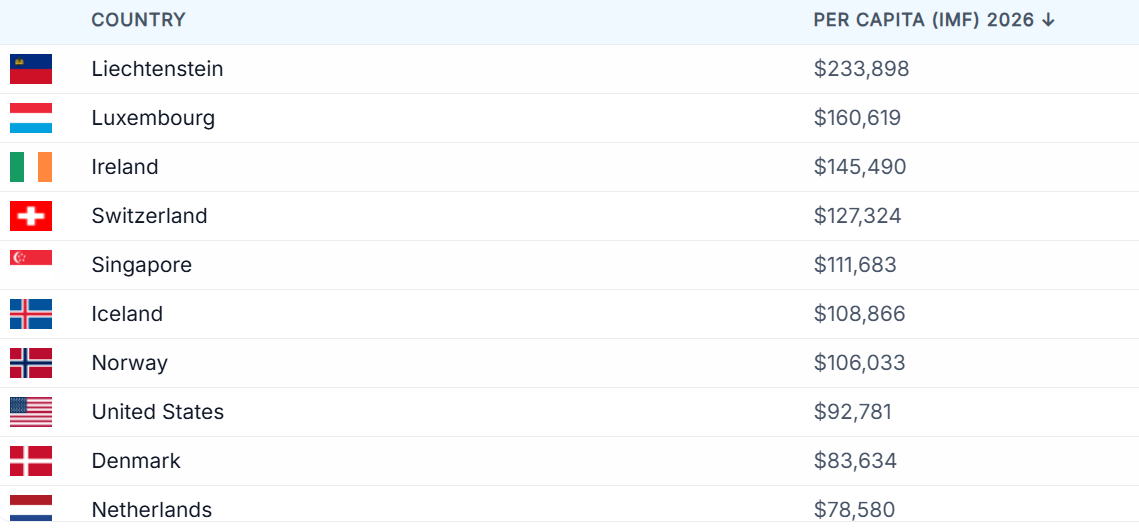
Source: World Population Review
Source: World Population Review
World’s richest countries

1. LiechtensteinLiechtenstein is mentioned among the world’s richest countries because of its high GDP per capita and strong financial sector. The country has a small population but a highly developed economy built around banking, financial services and specialised manufacturing. Low taxes and close economic ties with neighbouring European countries have also helped strengthen its economy. 2. LuxembourgLuxembourg’s economy revolves heavily around banking, investment management and financial services. Its location in central Europe helped it develop into a major financial hub despite its small size.Large numbers of cross-border workers travel daily from neighbouring countries, contributing to economic output that strengthens Luxembourg’s per-person income figures further. Finance remains dominant, though technology and logistics have also expanded steadily.3. IrelandIreland has seen a sharp rise in economic output over the past two decades. International technology and pharmaceutical companies established major operations there, attracted partly by corporate tax policies and access to European markets.This concentration of multinational activity pushed Ireland’s GDP figures significantly higher than many expected. Dublin developed into one of Europe’s largest technology centres, with strong links to software, digital advertising and cloud computing industries.4. SwitzerlandSwitzerland remains closely associated with wealth, though modern Swiss prosperity depends on far more than banking alone. Pharmaceuticals, precision engineering, insurance and luxury manufacturing all contribute heavily to the economy.Swiss products are often positioned in high-value global markets where quality and reliability carry significant weight. The country also benefits from political stability and a long-established financial system.5. SingaporeSingapore built its economy through trade, shipping, finance and advanced manufacturing. Positioned along some of the world’s busiest maritime routes, the city-state developed into one of Asia’s strongest commercial centres.Limited land and natural resources pushed Singapore towards specialised industries that generate high economic value. Financial services, electronics and biomedical sectors now form major parts of its economy.6. IcelandIceland combines renewable energy resources, tourism and fishing into a relatively high-income economy. The country benefits from abundant geothermal and hydroelectric energy, which supports the domestic industry and reduces energy costs.Tourism became increasingly important during the past decade, particularly after international travel interest in Iceland’s landscapes and natural attractions grew rapidly.7. NorwayNorway owes much of its wealth to North Sea oil and gas reserves. Unlike many energy exporters, Norway channelled large portions of this income into a sovereign wealth fund designed for long-term investment.The country also maintains strong industries in shipping, seafood and renewable energy. High wages and extensive public services remain closely tied to the country’s broader economic model.8. United StatesThe United States remains the world’s largest economy overall, even if several smaller countries rank above it in GDP per capita. Technology, finance, defence, healthcare and entertainment collectively generate enormous economic output.Cities such as New York City and San Francisco continue to shape global markets, particularly in finance and technology investment.9. DenmarkDenmark maintains high income levels through manufacturing, shipping, renewable energy and pharmaceuticals. Danish companies hold strong international positions in sectors such as wind energy and logistics.The country is also recognised for combining private enterprise with extensive welfare systems and relatively high living standards.10. NetherlandsThe Netherlands benefits from international trade, transport infrastructure and financial services. The Port of Rotterdam remains one of Europe’s busiest shipping gateways, linking continental markets with global trade routes.Agriculture also plays a larger role than many expect. Despite its size, the Netherlands became one of the world’s largest agricultural exporters through highly efficient farming systems.